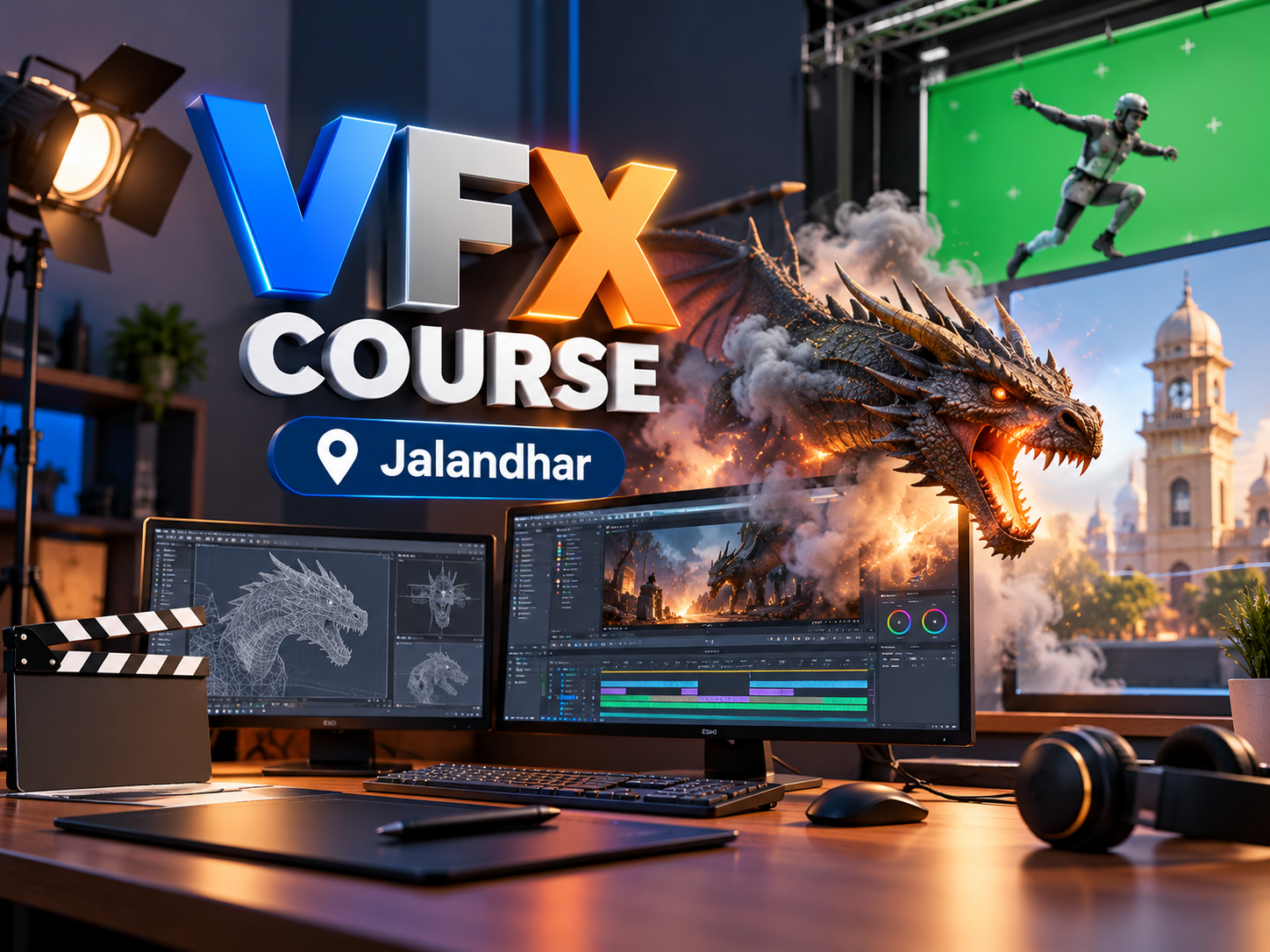
VFX Course in Jalandhar
Visual effects help filmmakers and content creators build images that would be difficult, expensive, or impractical to capture entirely during filming. A scene might combine recorded footage with a digital environment, a replaced background, or additional visual elements. Other effects may be almost invisible, such as removing a distracting object or repairing part of a shot.
A VFX Course in Jalandhar can introduce students to the creative and technical processes behind this work. Learning involves observation, image analysis, software skills, and an understanding of how different production stages connect.
Students can contact IAM Jalandhar to discuss relevant learning options, prerequisites, practical facilities, and course availability. A structured approach helps beginners progress from simple exercises towards complete visual effects shots.
What Is VFX?
VFX stands for visual effects. It refers to creating, combining, or altering images to achieve a planned result. The work can involve recorded footage, photographs, computer-generated elements, masks, and other visual information.
Visual effects may support realistic storytelling or create an intentionally stylised world. The technique should suit the project and help communicate its purpose.
Visual Effects Training in Jalandhar can introduce tasks such as:
Combining foreground and background images.
Removing unwanted objects.
Replacing screens or signs.
Creating masks that follow movement.
Integrating rendered elements with footage.
Adjusting colour, edges, and image characteristics.
Preparing finished shots for review.
These tasks require attention to both individual details and the complete image.
Why Learn Visual Effects?
Visual effects combine artistic judgement with technical problem-solving. Students learn to inspect an image, identify differences between its elements, and make controlled adjustments.
The skills can support short films, promotional videos, creative projects, and further specialist learning. Students may discover that they prefer compositing, tracking, cleanup, or three-dimensional production.
Potential benefits include:
Developing stronger visual observation.
Understanding image-processing workflows.
Learning to troubleshoot creative problems.
Improving project organisation.
Practising detailed review.
Building a portfolio of completed exercises.
A VFX Training Course in Jalandhar should connect techniques with clear objectives. Understanding why a correction is needed is as important as knowing which tool can make it.
Who Can Join a VFX Course?
VFX can appeal to learners from creative and technical backgrounds. Some enjoy photography, drawing, or filmmaking, while others are interested in software, digital imagery, and problem-solving.
Previous design experience may help, but beginners can start with foundational image and computer skills.
Potential learners include:
School and college students.
Graduates exploring digital media.
Aspiring compositors.
Video editors expanding their skills.
Photographers interested in moving images.
Beginners exploring animation and effects.
Before selecting VFX Classes in Jalandhar, discuss the expected starting level, software access, hardware requirements, and practical assignments. Understanding the scope helps students choose a suitable learning path and prepare for independent practice.
Understanding the VFX Production Workflow
A visual effects shot usually passes through several stages. Planning begins with understanding what the finished image must communicate and which elements are required.
A beginner workflow may include:
Reading the brief.
Reviewing the source footage.
Identifying technical and creative requirements.
Preparing masks, tracks, or supporting assets.
Combining and adjusting elements.
Reviewing the complete shot.
Exporting and checking the result.
A VFX Course for Beginners in Jalandhar should explain these connections. A clear workflow makes it easier to identify the cause of a problem and avoid unnecessary corrections later.
Students should also record assumptions about source material, frame ranges, and output requirements.
Image Fundamentals for VFX Students
Before attempting complex effects, beginners should understand the basic characteristics of digital images. Resolution, frame rate, aspect ratio, channels, and image sequences influence how material is processed and delivered.
Students should distinguish between a still image and a moving shot. An effect that looks correct on one frame may fail when the subject moves or the lighting changes.
Useful foundations include:
Reading image dimensions.
Understanding frame ranges.
Recognising colour and alpha channels.
Comparing sharpness and blur.
Inspecting noise and grain.
Reviewing footage at normal playback speed.
These concepts help learners ask useful questions before selecting a tool or changing settings.
Introduction to Compositing
Compositing combines visual elements into a single result. It can involve placing a subject over a background, integrating a rendered object, or combining several image-processing operations.
A convincing composition requires consistency. Elements need to agree in perspective, lighting, colour, sharpness, and movement.
A Compositing Course in Jalandhar can introduce:
Foreground and background relationships.
Transparency and masks.
Image-combination operations.
Positioning and scale.
Colour adjustments.
Edge treatment.
Reviewing intermediate results.
Begin with simple material that already contains suitable transparency. This allows students to understand image combination before adding the challenges of keying, tracking, and cleanup.
The first objective should be a clear, understandable composition.
Node-Based and Layer-Based Workflows
Different applications organise compositing operations in different ways. A layer-based workflow commonly arranges elements within a stack, while a node-based workflow represents processing steps through connected operations.
Both approaches require clear organisation and an understanding of processing order. Changing that order can affect the result.
Students exploring VFX Compositing Training in Jalandhar can practise:
Identifying source elements.
Following the processing sequence.
Comparing intermediate outputs.
Naming important operations.
Keeping related work organised.
Removing unnecessary experiments.
The objective is a readable project. Another person should be able to understand how the shot was built and where important adjustments occur.
Rotoscoping and Animated Masks
Rotoscoping involves creating shapes or masks that follow selected areas over time. These masks can isolate a subject, limit an adjustment, or protect part of an image.
Beginners should start with straightforward movement and manageable shapes. A short exercise provides enough material to practise accuracy without becoming overwhelming.
Rotoscoping Training in Jalandhar can develop:
Careful shape placement.
Consistent edge treatment.
Keyframe management.
Tracking-assisted workflows where suitable.
Frame-by-frame review.
Organisation of multiple shapes.
Check the entire frame range. A mask may appear correct at the beginning and end while drifting during the movement between them. Normal-speed playback is also important because some inconsistencies become more noticeable in motion.
Green Screen and Chroma Keying
Keying separates a subject from a background using selected image characteristics. Green screen footage is a familiar example.
The result depends partly on how the footage was recorded. Uneven backgrounds, colour spill, motion blur, and fine details can make extraction more difficult.
Green Screen Training in Jalandhar can introduce:
Inspecting source footage.
Understanding matte quality.
Preserving required subject detail.
Managing unwanted background colour.
Reviewing hair and fine edges.
Checking results over different backgrounds.
Students should examine transparency separately from the colour image. A composition may look acceptable over one background while revealing edge problems over another. Review the complete shot before considering the extraction finished.
Tracking and Match Movement
Tracking analyses movement within a shot so another element can follow it. Applications include attaching graphics, replacing screen content, or supporting other integration tasks.
Different methods suit different movement and image characteristics. Beginners should start with footage containing clear features and limited complications.
A VFX Tracking Course in Jalandhar can introduce:
Selecting useful tracking information.
Reviewing accuracy.
Identifying drift.
Applying movement to another element.
Checking perspective.
Inspecting the full frame range.
A successful track is only one stage. A replacement may still need appropriate colour, reflections, blur, and edge treatment to belong in the shot.
Cleanup and Paint Work
Cleanup involves removing or repairing unwanted visual details. Examples include replacing a distracting mark or repairing a small background area.
The difficulty depends on movement, texture, lighting changes, and whether other elements pass in front of the area being repaired.
Useful VFX Cleanup Training in Jalandhar exercises can focus on:
Studying surrounding texture.
Choosing suitable reference material.
Matching movement.
Checking changing light.
Avoiding visible repeated patterns.
Reviewing repairs during playback.
Begin with a short, controlled shot. Students should understand the repair process before attempting large removals or footage with complex camera movement.
Save versions so different approaches can be compared without losing earlier work.
Colour Matching and Visual Integration
Elements from different sources often differ in brightness, contrast, colour balance, and sharpness. These differences can make the final image feel disconnected.
Start by comparing the source material. Identify the main mismatch before applying adjustments.
Useful integration checks include:
Lighting direction.
Highlight and shadow relationships.
Overall colour balance.
Contrast and saturation.
Edge sharpness.
Motion blur.
Grain or noise.
During Visual Effects Compositing Training in Jalandhar, students should change one major characteristic at a time. Controlled adjustments make it easier to understand what improved the shot and what introduced a new problem.
A consistent image usually develops through several purposeful decisions rather than one large correction.
Understanding Colour Management
Colour management helps maintain a consistent interpretation of image values across sources, processing, viewing, and delivery.
Beginners should understand that image appearance depends partly on how material is interpreted and displayed. Incorrect settings can cause confusion when comparing footage, rendered assets, and exported results.
Students do not need to memorise an entire production pipeline immediately. They should learn to identify the project’s expected settings and ask about unclear source information.
Record important assumptions and follow the agreed workflow. Avoid making large creative corrections to compensate for a technical interpretation problem that should be addressed earlier in the process.
Introduction to 3D Elements in VFX
Some visual effects shots include digitally created objects or environments. These elements may be modelled, textured, lit, animated, and rendered before being combined with footage.
A 3D and VFX Course in Jalandhar can introduce how these stages relate without requiring beginners to master every specialisation at once.
Important integration considerations include:
Scale and position.
Camera perspective.
Lighting relationships.
Shadows and contact.
Reflections.
Motion.
Suitable render information.
Compositing adjustments cannot solve every source problem. If an object’s perspective or lighting is unsuitable, the project may require changes to the three-dimensional scene or render.
Understanding these relationships supports better communication between artists.
Choosing and Learning VFX Software
Different applications support different production tasks. Students should understand the purpose of the software being taught and how it connects with practical projects.
When exploring a VFX Software Course in Jalandhar, ask which applications are included and whether the training focuses on compositing, tracking, cleanup, three-dimensional work, or a combination.
Useful beginner habits include:
Learning navigation before complex operations.
Understanding inputs and outputs.
Saving organised project versions.
Naming layers or nodes clearly.
Reviewing results frequently.
Reading relevant software guidance.
Repeating exercises independently.
Software knowledge becomes more valuable when students can explain the visual problem and why a selected technique addresses it.
A Practical First VFX Project
Choose a manageable project that introduces a small number of concepts. One example is placing a foreground object with suitable transparency over a background.
A beginner exercise can follow these steps:
Define the intended result.
Collect appropriately licensed source material.
Inspect dimensions and channels.
Position the foreground.
Combine the elements.
Adjust appearance carefully.
Review edges and consistency.
Export and inspect the saved output.
Useful VFX Projects for Beginners in Jalandhar should remain achievable. Tracking, keying, and complex cleanup can be introduced in later exercises once the basic workflow is understood.
Document what changed between the first version and the final result.
Common Beginner Mistakes to Avoid
Many early problems arise when students apply effects before analysing the source material. Others result from poor organisation or checking only a single frame.
Common mistakes include:
Ignoring image dimensions or frame ranges.
Using unsuitable source material.
Overlooking transparency problems.
Making excessive colour adjustments.
Failing to review movement.
Keeping unclear project structures.
Skipping the exported-file check.
Attempting too many unfamiliar techniques simultaneously.
A careful review process helps identify these issues. Compare intermediate results and record what changed. Understanding the cause of a mistake provides more useful learning than hiding it with additional operations.
Building a VFX Portfolio
A portfolio should show selected work and explain the learner’s contribution. Short, carefully reviewed exercises can communicate strong foundations.
Useful examples include a simple integration, a roto exercise, a controlled key, a cleanup task, and a tracked replacement.
For each project, explain:
The objective.
The source material.
Your responsibilities.
The main challenge.
The approach used.
Important revisions.
Any remaining limitations.
Clearly credit supplied footage, rendered assets, and other resources. A breakdown helps viewers understand the work behind the finished image and distinguishes personal contributions from provided material.
Select work thoughtfully rather than including every practice exercise.
Exploring VFX Learning with IAM Jalandhar
When considering an IAM VFX Course in Jalandhar, explain whether your main interests involve compositing, tracking, cleanup, keying, or three-dimensional production.
Ask about prerequisites, software coverage, practical assignments, instructor feedback, and expected independent practice. Confirm course availability, duration, batch timings, equipment needs, and additional software costs directly with IAM Jalandhar.
A suitable learning plan should connect image fundamentals with achievable projects. Students should understand how their work will be reviewed and which topics receive introductory or more detailed attention.
Clear expectations help learners set realistic goals, choose meaningful portfolio exercises, and plan further study.
Conclusion
A VFX Course in Jalandhar can introduce the observation, compositing, masking, tracking, keying, and review skills involved in visual effects. Strong results depend on suitable source material, organised workflows, and consistent attention to detail.
Contact IAM Jalandhar to discuss relevant learning options. Begin with manageable exercises, review the complete shot, and build a portfolio that demonstrates both technical understanding and thoughtful visual judgement.
Explore Visual Effects Learning with IAM
Explore VFX with IAM in Hoshiarpur. Gain skills in compositing, rotoscoping, keying and tracking, then turn creative ideas into visual projects. Get course details today!
Tell us whatyou wantto create.
A few lines about yourself and the course you're interested in. Our admissions team replies within two working days, and you can book a free campus visit or demo class.
Call admissions→Or send an enquiry to your nearest campus- Phone
- +91 98881 22241
- Address
- 1st Floor, IAM, Crystal Plaza, SCS 78, opp. PIMS Hospital, Jalandhar, Punjab 144001