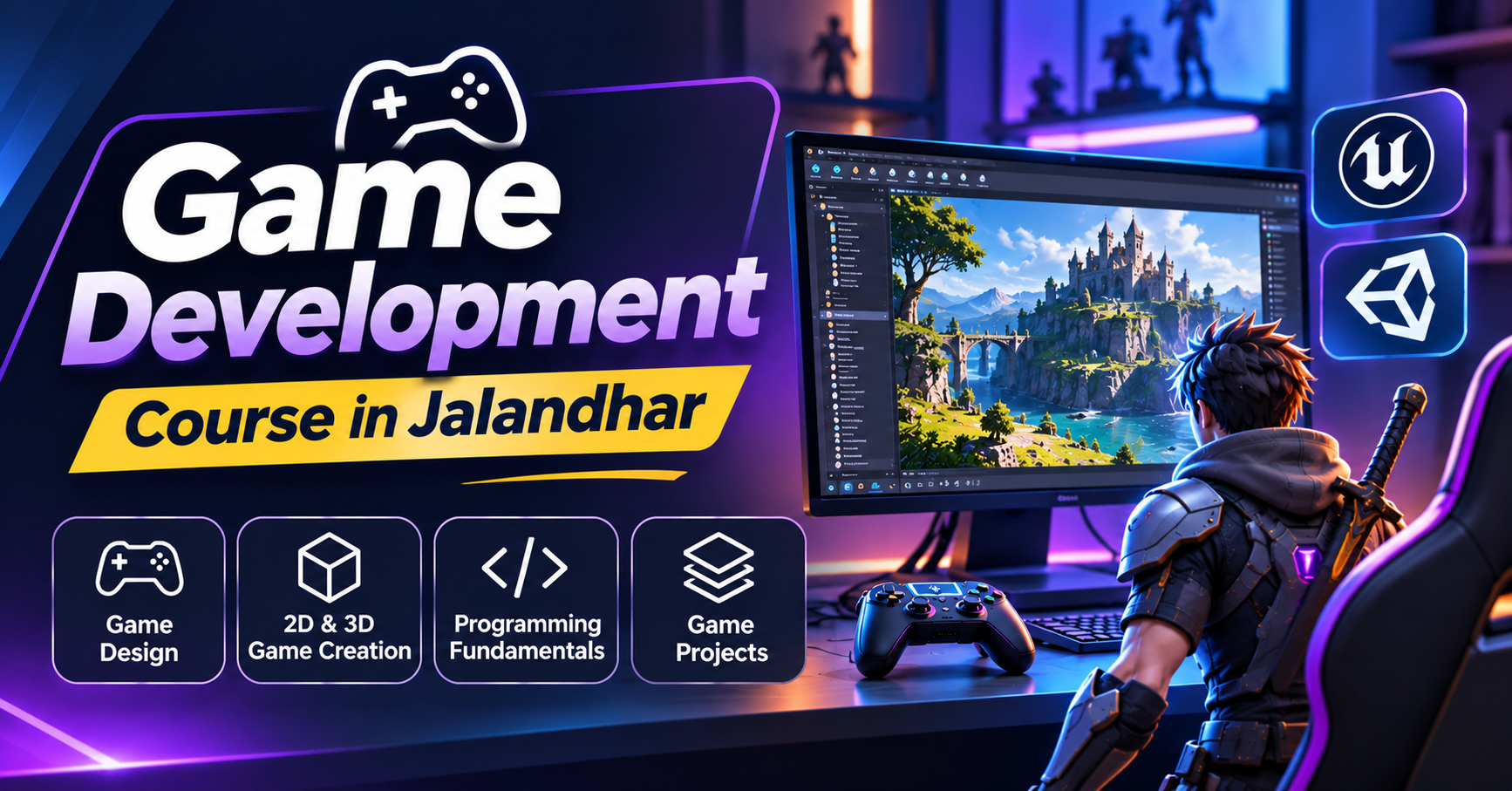
Game Development Course in Jalandhar
Game Development Course in Jalandhar
Have you ever imagined creating your own video game, designing exciting virtual worlds, or developing interactive gaming experiences? Game development combines creativity, technology, storytelling, design, and programming to transform ideas into playable digital experiences. If you want to explore this exciting field, joining a Game Development Course in Jalandhar can be a great starting point.
At IAM Jalandhar, learners can explore the fundamentals of game development and understand how games are designed, developed, and brought to life. Through structured learning and practical exercises, students can develop knowledge of game design concepts, 3D environments, character interaction, animation, gameplay mechanics, and game development tools.
Whether you are a beginner interested in creating your first game or a creative learner looking to build technical skills, game development offers opportunities to combine imagination with technology.
Explore the Fundamentals of Game Development
Game development involves several stages, including concept creation, game design, environment development, programming, animation, testing, and final production.
Understanding the development process helps learners recognise how different elements work together to create an engaging gaming experience.
The introductory topics may include:
Introduction to the gaming industry.
Understanding game development workflows.
Types of video games and gaming platforms.
Game concepts and storytelling.
Game mechanics and player interaction.
Understanding game levels and environments.
Introduction to game development engines.
Basic game production processes.
Game testing and debugging fundamentals.
These concepts help students understand the creative and technical aspects of developing a video game.
Learn Game Design and Gameplay Mechanics
Game design is about creating the rules, objectives, challenges, and experiences that make a game enjoyable. A well-designed game combines engaging gameplay with clear objectives and interactive elements.
Learners can explore:
Game concept development.
Game rules and objectives.
Gameplay mechanics.
Player movement and interaction.
Level design fundamentals.
Game progression and challenges.
Character abilities and behaviours.
User experience in gaming.
Basic game balancing concepts.
Understanding these principles helps learners plan games that are engaging, structured, and enjoyable to play.
Understand Game Engines and Development Tools
Game engines provide the technical foundation for creating interactive gaming experiences. They allow developers to build environments, manage game assets, create interactions, and develop gameplay functionality.
Depending on the course syllabus, learners may explore tools such as:
Unreal Engine.
Unity.
Blender for 3D assets.
Visual scripting systems.
Game development editors.
Basic programming tools.
Students can understand how game engines help bring together graphics, physics, animation, sound, and gameplay elements.
Create 2D and 3D Game Environments
A game's environment plays an important role in its visual identity and overall experience. Game developers create different worlds, locations, backgrounds, and interactive spaces based on the game's concept.
Learning topics may include:
Introduction to 2D and 3D game environments.
Scene creation and management.
Working with game objects.
Importing and organising assets.
Environment composition.
Terrain and landscape design.
Creating indoor and outdoor scenes.
Basic environmental lighting.
Game level layout.
These skills help learners understand how virtual spaces are designed for different types of games.
Explore Character Design and Animation
Characters are an important part of many gaming experiences. Their movement, appearance, expressions, and interactions contribute to the overall gameplay.
Students may explore:
Introduction to game characters.
Character asset integration.
Basic character movement.
Animation fundamentals.
Character interaction.
Animation sequences.
Camera movement and positioning.
Character behaviour concepts.
Integrating animated assets into scenes.
These techniques help learners understand how characters are brought into interactive game environments.
Learn Game Programming and Visual Scripting
Programming and visual scripting are used to define how a game behaves. They control player movement, object interaction, game rules, scoring systems, and other gameplay features.
Depending on the selected development engine, learning topics may include:
Introduction to programming logic.
Variables and data types.
Conditions and loops.
Functions and events.
Object interaction.
Player movement controls.
Collision detection.
Basic game logic.
Blueprint visual scripting.
Introduction to debugging.
These concepts help learners understand how interactive features are developed and connected within a game.
Understand Game Physics, Lighting, and Sound
A realistic and engaging game requires more than attractive graphics. Physics, lighting, sound, and visual effects contribute to the player's experience.
The course may introduce:
Basic game physics.
Collision and object movement.
Lighting and shadow techniques.
Materials and textures.
Visual effects fundamentals.
Background music and sound effects.
Camera effects.
Scene rendering.
Game performance basics.
Understanding these elements helps students create more immersive and visually engaging gaming experiences.
Practical Game Development Projects
Practical assignments allow students to apply their learning and understand the complete process of building interactive experiences.
Possible project activities may include:
Creating a simple 2D game.
Developing a basic 3D environment.
Designing a player movement system.
Building an interactive obstacle course.
Creating a simple racing game environment.
Developing a basic platform game.
Creating interactive objects.
Designing a game level.
Building a small playable game prototype.
Working on projects helps learners improve their problem-solving abilities, creativity, technical understanding, and portfolio development.
Who Can Join a Game Development Course in Jalandhar?
Game development can be suitable for learners who enjoy gaming, technology, storytelling, animation, and creative digital production.
The course may be useful for:
School and college students.
B.Tech and Computer Science students.
BCA and MCA students.
Animation and multimedia learners.
Design students.
Aspiring game developers.
3D artists interested in interactive environments.
Beginners interested in gaming technology.
Creative professionals exploring game development.
No professional game development experience is required to begin learning the fundamentals. Interest in gaming, creativity, and willingness to practise can help learners get started.
Career Opportunities After Learning Game Development
Game development skills can be applied across gaming, entertainment, interactive media, simulation, and real-time 3D production.
Depending on your technical abilities, portfolio, education, and experience, possible career pathways include:
Junior Game Developer.
Game Designer.
Game Level Designer.
Unity Developer.
Unreal Engine Artist.
3D Game Artist.
Game Environment Artist.
Game Tester.
Gameplay Programmer.
Technical Artist – Entry Level.
Developing additional skills in programming, 3D modelling, animation, and game engine workflows can help learners explore specialised opportunities in the gaming industry.
Why Choose IAM for Game Development Training in Jalandhar?
Learning game development requires a combination of creative thinking, technical understanding, and practical application. Choosing a training programme that introduces both design concepts and development workflows can help learners build a stronger foundation.
At IAM Jalandhar, students can explore game development through structured learning and practical creative activities. The training focuses on understanding game design, interactive environments, game engine fundamentals, character animation, gameplay mechanics, and project development.
Learners can explore how different creative and technical elements work together to produce interactive gaming experiences.
Before enrolling, students can enquire about the course syllabus, software tools, practical assignments, project work, and available batches.
If you are searching for a Game Development Course in Jalandhar, IAM offers an opportunity to explore game creation and develop foundational skills for the digital gaming industry.
Start Creating Your Own Games with IAM Jalandhar
The gaming industry brings together technology, creativity, design, and storytelling. Learning game development can help you understand how interactive experiences are created, from the first concept to a playable game.
Join the Game Development Course at IAM Jalandhar and begin exploring game design, programming fundamentals, 2D and 3D environments, animation, gameplay mechanics, and interactive development.
Contact IAM today to enquire about course details, syllabus, available batches, and admission information.
Turn Your Gaming Ideas into Reality.
Explore game development at IAM Jalandhar. Learn game design, 2D and 3D environments, character animation, gameplay mechanics, programming fundamentals, and interactive development through practical learning.
Tell us whatyou wantto create.
A few lines about yourself and the course you're interested in. Our admissions team replies within two working days, and you can book a free campus visit or demo class.
Call admissions→Or send an enquiry to your nearest campus- Phone
- +91 98881 22241
- Address
- 1st Floor, IAM, Crystal Plaza, SCS 78, opp. PIMS Hospital, Jalandhar, Punjab 144001