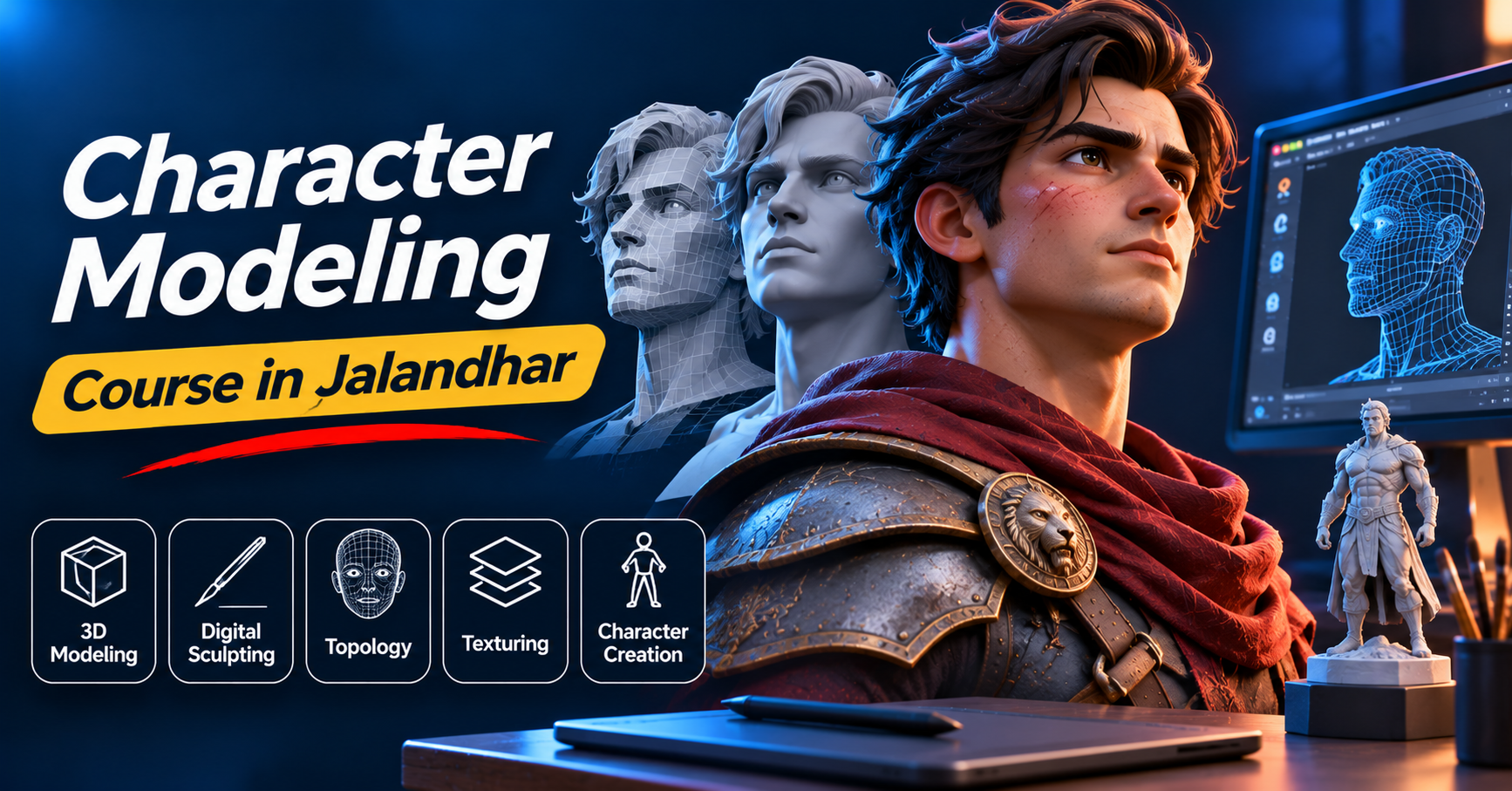
Character Modeling Course in Jalandhar
From Creative Concepts to Fully Developed 3D Characters
Every memorable animated character begins with an idea. Whether it is a realistic human character, a stylised cartoon figure, a fantasy creature or a hero designed for a video game, character modeling transforms imagination into three-dimensional digital form.
The Character Modeling Course in Jalandhar at IAM is designed for individuals who want to explore the art and techniques of creating 3D characters. The course introduces learners to character development, human anatomy, proportions, digital sculpting, polygon modeling, topology, detailing and professional 3D modeling workflows.
Students learn how to understand character references, develop basic shapes, construct body structures and gradually add details to create visually appealing 3D models. The training focuses on the relationship between artistic observation and technical modeling skills, helping learners understand how characters are developed for animation, gaming, films and digital entertainment.
From designing facial features to sculpting clothing, accessories and body details, character modeling involves several creative stages. Learning these processes can help aspiring artists develop the skills required to create original digital characters and explore opportunities in the 3D design industry.
Discover the Art of 3D Character Modeling
3D character modeling is the process of creating digital characters using specialized modeling software. It involves developing the shape, structure and appearance of a character in a three-dimensional environment.
Unlike traditional illustrations, 3D characters can be viewed from different angles and prepared for animation, rendering or interactive applications.
Character modeling combines artistic elements such as anatomy, proportions, facial expressions and clothing with technical concepts such as polygon geometry, topology and mesh organisation.
At IAM, Jalandhar, learners are introduced to the fundamentals of character creation and understand how different modeling techniques contribute to the final appearance of a digital character.
Understand Human Anatomy and Character Proportions
An understanding of anatomy helps artists create characters with balanced proportions and believable body structures.
Students explore the basic structure of the human body, including the head, torso, arms, legs, hands and feet. They learn how proportions change depending on the character's age, personality, artistic style and design requirements.
The training also introduces facial anatomy, including the eyes, nose, mouth, jawline and other important features.
By understanding these fundamentals, learners can create characters that look more natural and maintain visual consistency throughout the modeling process.
Master 3D Sculpting and Digital Form Development
Digital sculpting allows artists to shape and refine 3D models much like working with traditional clay.
It is particularly useful for developing organic forms, facial structures, muscles, clothing folds, skin details and fantasy character features.
Learners explore how sculpting brushes and digital tools can be used to add volume, refine shapes and develop surface details.
They understand the importance of starting with basic forms before moving towards smaller details. This approach helps maintain the overall structure of a character while improving its visual quality.
Learn Polygon Modeling and Mesh Creation
Polygon modeling is an important technique used to construct 3D characters through vertices, edges and faces.
Students understand how these components form the geometry of a character and how different modeling tools help create complex shapes.
The learning process introduces extrusion, subdivision, edge loops, mesh editing and polygon refinement.
Learners also explore how to build different body parts and connect them into a complete character model.
Understanding polygon modeling provides a technical foundation for creating structured 3D assets that can be further refined, textured and prepared for animation.
Explore Topology and Clean Edge Flow
Good topology is essential for creating functional and organised 3D characters. It determines how the polygon structure is distributed across the model.
Proper edge flow is particularly important around areas such as the shoulders, elbows, knees, mouth and eyes, where movement and deformation may occur.
Learners explore how to organise polygon geometry, maintain clean mesh structures and reduce unnecessary complexity.
They understand why topology matters when preparing characters for rigging, animation and further production stages.
Develop Detailed Facial Features and Expressions
A character's face communicates identity, personality and emotion. Even small differences in facial structure can significantly change how a character looks.
Students explore the modeling of eyes, eyelids, eyebrows, noses, lips, ears and facial structures.
They learn how to refine facial proportions and develop different visual styles, ranging from realistic human faces to exaggerated cartoon characters.
Facial modeling exercises help learners understand symmetry, surface transitions and the importance of small details in character development.
Create Clothing, Accessories and Character Details
A character's identity is influenced by more than its body structure. Clothing, footwear, hairstyles, armour and accessories contribute to its overall appearance.
The course introduces learners to modeling different character elements, including outfits, belts, shoes, jewellery, helmets and other accessories.
Students explore how different materials and shapes can be represented through 3D geometry.
They also understand how clothing folds, layered structures and surface details add depth to a character's design.
These techniques are useful when developing characters for games, animated productions, fantasy artwork and digital storytelling.
Explore Realistic and Stylised Character Modeling
Character modeling offers different creative approaches depending on the purpose of the project.
Realistic character modeling focuses on accurate anatomy, detailed facial structures, natural proportions and believable surface forms.
Stylised character modeling uses creative exaggeration, simplified geometry and distinctive proportions to develop memorable visual identities.
Learners explore different character styles and understand how modeling techniques change according to artistic requirements.
Possible approaches include:
Realistic Human Characters: Develop believable human proportions, facial structures and anatomical details.
Cartoon Characters: Create expressive figures with exaggerated features and distinctive proportions.
Fantasy Characters: Model imaginative creatures, heroes and fictional personalities.
Game Characters: Develop characters with organised geometry suitable for game production workflows.
Creature Modeling: Explore the modeling of animals, monsters and fictional creatures.
Stylised Characters: Experiment with unique shapes, simplified forms and artistic proportions.
Understanding these styles allows learners to explore different creative directions and develop their own modeling approach.
Understand Texturing and Material Preparation
After modeling, textures and materials help define the visual appearance of a character.
They determine the colours, surface characteristics and material properties of different parts of the model.
Learners explore the relationship between geometry, UV mapping, materials and texturing. They understand how skin, fabric, leather, metal and other surfaces can be represented in a 3D environment.
The training introduces the importance of preparing character models for further texturing and rendering workflows.
Prepare Characters for Rigging and Animation
A character model may eventually be used in animation, gaming or digital production. For this reason, modeling decisions can influence how easily the character can be rigged and animated.
Students understand the importance of clean topology, organised geometry and suitable proportions when preparing characters for rigging.
They explore how different body structures and mesh arrangements affect future movement and deformation.
This knowledge helps learners understand the connection between character modeling, rigging and animation within a professional 3D production pipeline.
Create Practical 3D Character Modeling Projects
Practical assignments help learners apply modeling techniques to different character concepts.
Possible project areas include:
Human Head Modeling: Develop facial structures, proportions and detailed features.
Full-Body Character: Create a complete 3D human character with balanced body proportions.
Cartoon Character: Design an expressive stylised character with distinctive features.
Fantasy Character: Develop imaginative creatures, heroes and fictional personalities.
Character Clothing: Model outfits, shoes, accessories and other design elements.
Creature Modeling: Experiment with animal anatomy and fantasy creature structures.
Game Character Model: Develop a character with organised geometry suitable for a game production workflow.
Character Presentation: Prepare the completed model for materials, lighting and final rendering.
These projects help learners understand the character creation process while building a collection of practical 3D artwork.
Understand Character Modeling Across Different Industries
3D character modeling plays an important role in several creative industries.
In gaming, character artists develop heroes, villains, supporting characters and creatures that become part of interactive environments.
Animation studios use 3D character models as the foundation for animated performances and storytelling.
Film and visual effects productions use digital characters and creatures to create scenes that may be difficult to capture through live-action filming.
Character modeling is also relevant to advertising, virtual experiences, digital collectibles and educational content.
Understanding these applications helps learners explore how their modeling skills can contribute to different creative production environments.
Who Should Join the Character Modeling Course?
The Character Modeling Course at IAM, Jalandhar, is suitable for individuals interested in 3D art, animation and digital character creation.
3D Animation Students: Understand how characters are developed before entering the animation stage.
Aspiring Character Artists: Learn techniques for creating original digital characters.
Game Design Enthusiasts: Explore character creation for video games and interactive experiences.
Digital Sculpting Enthusiasts: Develop skills in shaping and refining three-dimensional forms.
Graphic Design Students: Expand their knowledge into 3D modeling and digital art.
Animation Beginners: Understand the fundamentals of character construction and design.
Creative Artists: Convert traditional drawing and sketching interests into digital 3D artwork.
Working Professionals: Add character modeling knowledge to existing 3D design and animation skills.
Skills You Can Develop Through Character Modeling Training
Character modeling combines creative thinking with technical 3D production knowledge.
Important skills include:
3D character modeling fundamentals.
Human anatomy and proportions.
Digital sculpting techniques.
Polygon modeling.
Mesh creation and refinement.
Topology and edge flow.
Facial modeling and expressions.
Character body construction.
Clothing and accessory modeling.
Realistic and stylised character creation.
UV mapping fundamentals.
Material and texture preparation.
Character presentation and rendering.
Game-ready asset preparation.
Portfolio development.
These skills can complement knowledge in animation, rigging, gaming, visual effects and 3D design.
Career Opportunities After Learning Character Modeling
Character modeling skills can support different career directions in the animation, gaming and digital entertainment industries.
3D Character Modeler: Create three-dimensional characters for different creative projects.
Character Artist: Develop the visual appearance and structure of digital characters.
Digital Sculptor: Create detailed organic forms, creatures and character models using sculpting tools.
Game Character Artist: Develop characters and assets for video game production.
Creature Modeler: Design and model animals, monsters and imaginary creatures.
3D Modeler: Work on different types of three-dimensional assets and digital models.
Character Design Artist: Develop character concepts, visual appearances and creative identities.
Freelance 3D Artist: Work independently on character modeling and digital asset projects.
Career opportunities depend on artistic ability, technical knowledge, practical experience and portfolio quality.
Build a Professional Character Modeling Portfolio
A strong portfolio allows artists to showcase their modeling techniques, artistic understanding and ability to create different character styles.
Learners can develop a collection of projects that demonstrates their progress from basic shapes to detailed character models.
Portfolio projects may include realistic human heads, stylised cartoon characters, fantasy creatures, full-body models and detailed character accessories.
Presenting front, side and three-quarter views along with close-up details can help demonstrate the quality of the model.
A portfolio that includes clean topology views, sculpting details and final rendered presentations can also help communicate technical knowledge to potential employers and clients.
Why Choose IAM for Character Modeling Training in Jalandhar?
Character modeling requires creativity, patience and an understanding of three-dimensional form. Developing a good character involves several stages, from studying references and understanding proportions to refining geometry and preparing the final model.
IAM, Jalandhar, provides learners with an opportunity to explore character modeling fundamentals and understand how 3D characters are developed for digital production.
The learning approach focuses on anatomy, sculpting, polygon modeling, topology, facial structures, clothing and character detailing.
Students can explore different modeling styles, practise creative techniques and develop projects that demonstrate their understanding of 3D character creation.
The objective is to help aspiring artists build a foundation in character modeling and understand its applications in animation, gaming and digital entertainment.
The Future of 3D Character Modeling
Digital characters are becoming increasingly important in animated films, video games, virtual production, immersive environments and digital storytelling.
As 3D technology develops, artists are exploring more detailed character designs, realistic anatomy, stylised forms and efficient modeling workflows.
Modern production pipelines combine modeling with sculpting, texturing, rigging and rendering to develop complete digital characters.
However, artistic observation, anatomy, proportions and creative thinking remain essential. Software provides the tools, but the artist's understanding of form and design determines the quality of the final character.
Learning character modeling can help aspiring artists develop these skills and explore opportunities in the evolving world of 3D production.
Start Your Character Modeling Journey at IAM, Jalandhar
Every digital character begins with a concept that gradually takes shape through artistic imagination and technical skill.
The Character Modeling Course in Jalandhar at IAM introduces learners to anatomy, digital sculpting, polygon modeling, topology, facial detailing and professional character creation workflows.
Whether you want to create realistic human models, stylised cartoon characters, fantasy creatures or game-ready assets, developing character modeling skills can help you explore the world of 3D art.
Learn how to build three-dimensional forms, refine character details and transform creative concepts into complete digital models.
Join IAM, Jalandhar, and turn your imagination into extraordinary 3D characters.
Every Character Begins with an Idea
Explore how creative concepts develop into three-dimensional characters. Understand reference studies, basic shapes, proportions and modeling fundamentals. Learn how artists build the initial structure of a character before adding complex details and defining its visual identity.
Tell us whatyou wantto create.
A few lines about yourself and the course you're interested in. Our admissions team replies within two working days, and you can book a free campus visit or demo class.
Call admissions→Or send an enquiry to your nearest campus- Phone
- +91 98881 22241
- Address
- 1st Floor, IAM, Crystal Plaza, SCS 78, opp. PIMS Hospital, Jalandhar, Punjab 144001