What Is Generative AI? A Simple Guide for Jalandhar Students
Design, AI & Marketing · Preeti Jalandhar · 21 October 2026
Generative AI helps students create text, images, and code through simple instructions. Discover its uses, benefits, and limitations in this beginner guide for Jalandhar students. Explore learning opportunities with Techcadd and understand how to use AI creatively, effectively, and responsibly.
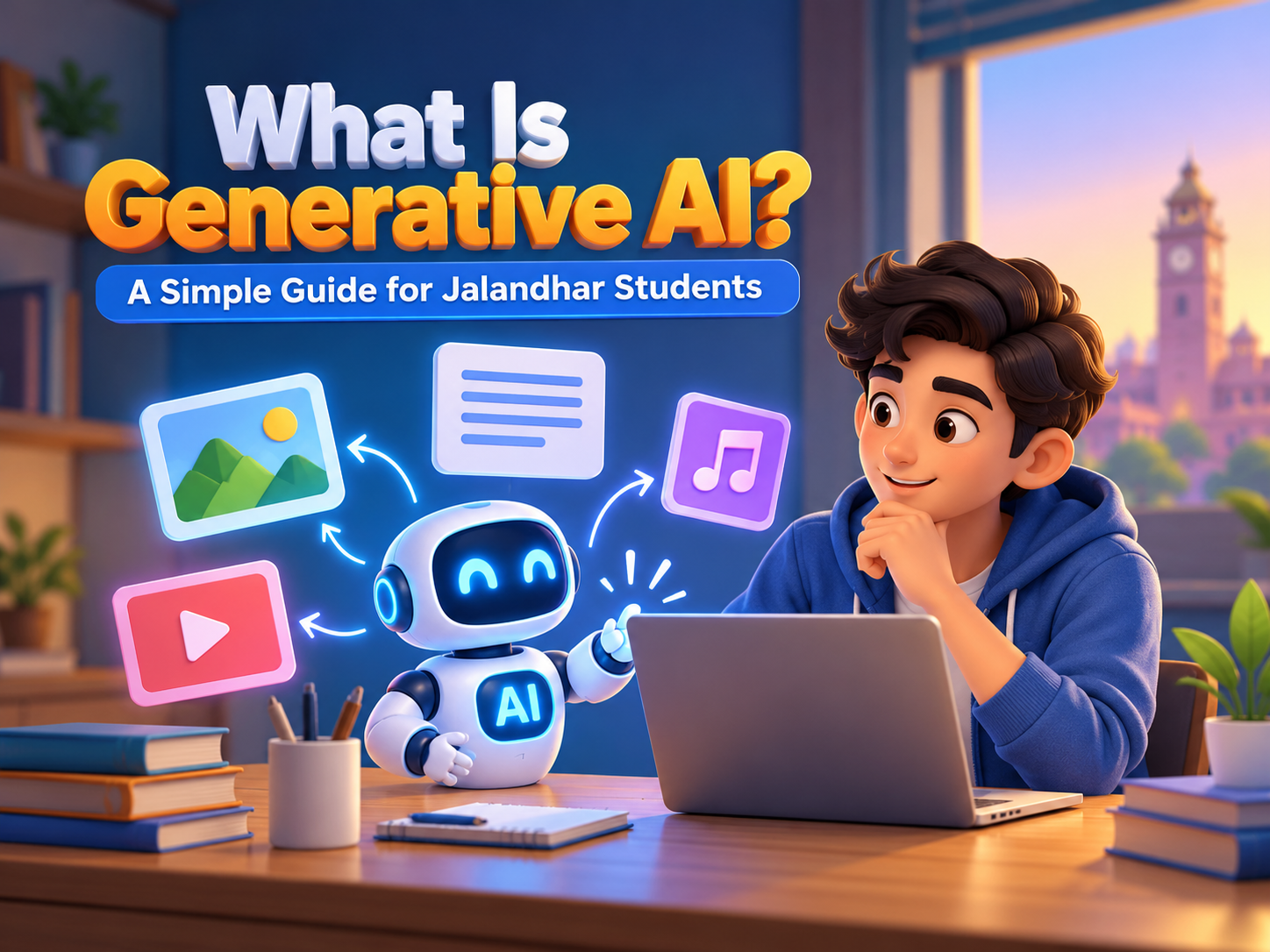
Imagine describing a poster and receiving a visual draft, asking for help understanding a difficult topic, or turning rough notes into a presentation outline. These are examples of tasks that generative artificial intelligence can support. The technology gives students new ways to explore ideas, practise communication, and approach creative projects.
However, using AI effectively requires more than typing a question. Students need to understand what these systems produce, why mistakes happen, and how to evaluate their responses.
This guide explains Generative AI for Jalandhar Students in straightforward language. Learners exploring the subject can also contact Techcadd Jalandhar to discuss relevant training options and learning requirements.
What Is Generative AI?
Generative AI is a type of artificial intelligence that produces content based on patterns learned during training. Depending on the system, it can generate text, images, audio, video, or computer code.
The word “generative” refers to this ability to create outputs. Instead of only identifying or sorting information, a generative system produces a response to instructions.
Examples include:
Writing a draft from a short description.
Creating an image from a detailed prompt.
Suggesting programming code for a defined task.
Producing practice questions from supplied notes.
Generating alternative headlines for a campaign.
Understanding What Is Generative AI begins with recognising that generated content still needs human review.
How Does Generative AI Work?
Generative AI models learn statistical relationships from training data. When someone enters a request, the model uses those learned patterns and the available context to generate an output.
For text generation, a model typically produces a sequence of small text units called tokens. Each part of the response is influenced by the instructions and preceding context.
A simple workflow looks like this:
The user provides instructions or reference material.
The system processes the available input.
The model generates a response.
The user checks and improves the result.
Generative AI Basics also include understanding that a convincing response can contain errors. Fluent language does not guarantee factual accuracy.
How Is Generative AI Different from Other AI?
Artificial intelligence is a broad field covering different methods and applications. Some systems classify information, estimate outcomes, or recommend items. Generative systems focus on producing content.
For example, one application might classify an email as spam. Another might draft an email based on instructions. These tasks involve different objectives, even though both use AI.
The categories can overlap within one product. An application may retrieve information, analyse it, and generate a written response.
For students exploring an Artificial Intelligence Course in Jalandhar, understanding these distinctions provides a useful foundation before studying specific tools or techniques.
What Can Generative AI Create?
Generative AI supports several content formats, although individual tools differ in their capabilities.
Text
Text systems can draft explanations, outlines, summaries, emails, and practice questions. Students should compare important claims with reliable learning material.
Images
Image systems can create illustrations, visual concepts, and design variations from descriptions. Outputs may require corrections to text, proportions, or other details.
Audio and Video
Some systems generate speech, music, or video. Responsible use requires attention to consent, permissions, and whether the content could mislead viewers.
Code
Coding assistants can suggest examples and explain programming concepts. Generated code needs inspection and testing before use.
These applications make Generative AI Training in Jalandhar relevant to learners with different interests.
How Can Students Use Generative AI?
Students can use generative AI as a support tool while keeping responsibility for their own understanding.
Useful learning activities include:
Requesting a simpler explanation of a concept.
Creating revision questions from class notes.
Exploring alternative approaches to a project.
Practising interview questions and answers.
Receiving suggestions for improving a draft.
Breaking a complex assignment into smaller tasks.
For example, a student could ask for an explanation of database relationships, then test their understanding by answering questions independently.
AI Learning for Students in Jalandhar should encourage active thinking. Copying an answer without understanding it offers little educational value and may conflict with assignment rules.
What Is a Prompt?
A prompt is the instruction or input given to an AI system. It can contain a question, task description, example, document, or combination of materials.
Clear prompts explain what is needed and provide relevant context.
Compare these requests:
“Explain marketing.”
“Explain digital marketing to a beginner in 150 words, with three examples relevant to a local clothing shop.”
The second request defines the audience, length, and context.
Prompt Engineering for Beginners involves improving instructions and reviewing how those changes affect results. Helpful details include the purpose, preferred format, available evidence, and important restrictions. Even a detailed prompt cannot guarantee a correct response.
Practical Projects for Jalandhar Students
Small projects help students understand the complete process of using AI, checking its output, and producing a finished result.
Suitable Generative AI Projects for Students include:
A revision quiz based on an approved chapter.
A presentation outline created from research notes.
A content calendar for a fictional business.
A visual concept board for a college event.
A comparison of responses to different prompts.
A beginner coding exercise with documented tests.
Each project should record the objective, instructions, revisions, and final checks. Explaining what the student corrected is valuable because it demonstrates judgement rather than simple tool use.
Limitations and Responsible Use
Generative AI can invent facts, misunderstand requests, reflect bias, or produce incomplete answers. It may also struggle when information is missing or the task requires precise reasoning.
Students should develop these habits:
Verify important information using reliable sources.
Check whether cited references actually exist.
Avoid sharing confidential or sensitive information.
Follow institutional rules for AI-assisted work.
Review outputs for unfair assumptions.
Respect permissions when using images or voices.
Learning Responsible AI Use for Students also means acknowledging assistance when required. AI should support learning without misrepresenting someone’s contribution or replacing necessary professional judgement.
Building Useful Skills with Techcadd
Students do not need to master every tool immediately. A stronger starting point is learning clear communication, source checking, editing, and basic digital skills.
When exploring a Generative AI Course in Jalandhar, ask about prerequisites, practical assignments, feedback, and responsible-use topics. Confirm which tools are included and whether subscriptions require additional payment.
Students considering Techcadd AI Training in Jalandhar can discuss their interests directly with the institute. Someone interested in design may need different projects from a learner focused on programming or marketing.
Clear goals help make training more purposeful and easier to evaluate.
Conclusion
Generative AI creates content from instructions, but useful results depend on clear goals and careful human review. For Jalandhar students, it offers opportunities to explore ideas, practise skills, and develop projects while learning to question outputs. Build your understanding gradually, use reliable sources, and connect with Techcadd Jalandhar to discuss suitable learning options.
- Generative AI
- Artificial Intelligence
- AI for Students
- Prompt Engineering
- AI Content Creation
- Generative AI Basics
- Responsible AI