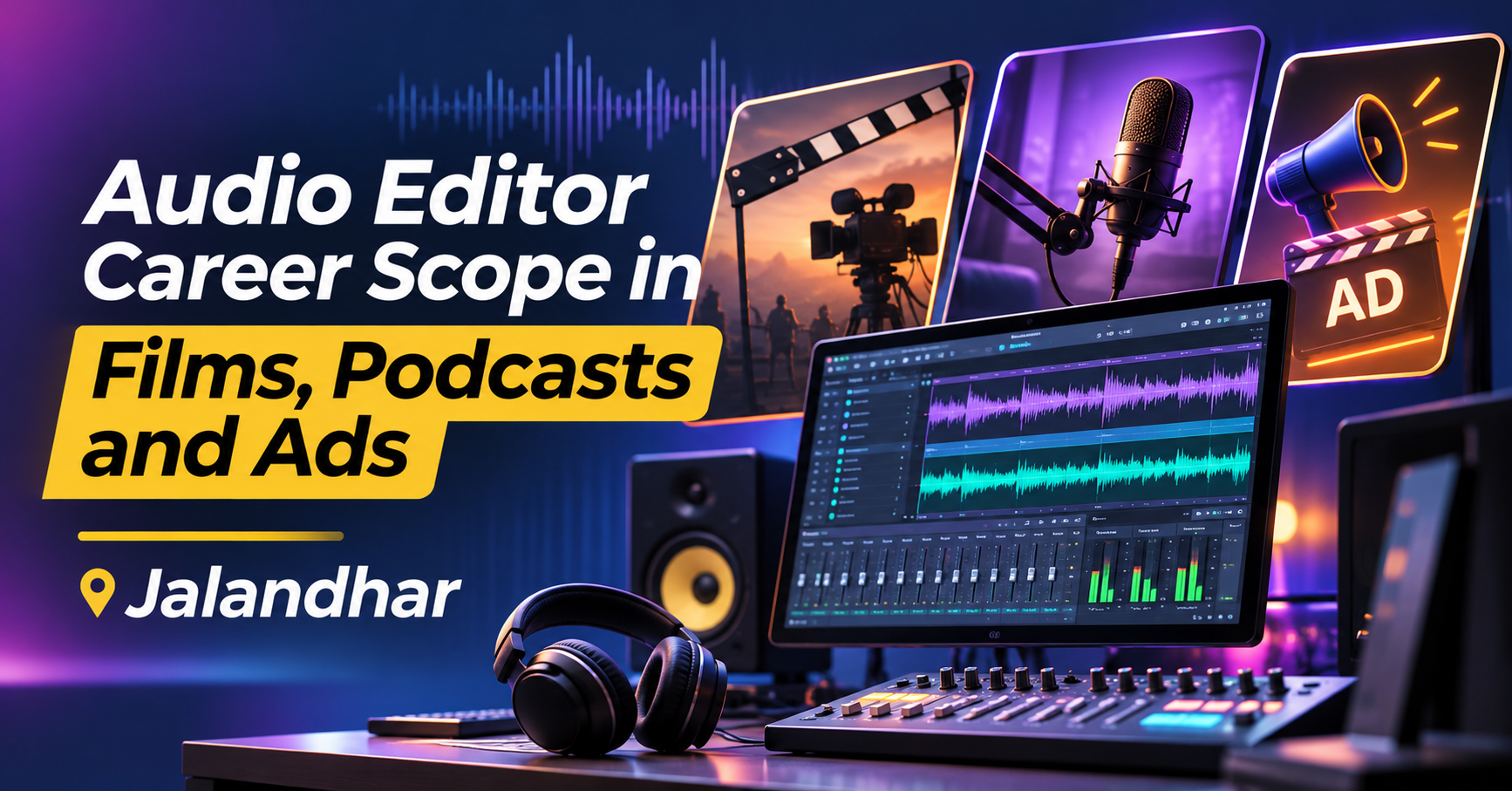
Audio Editor Career Scope in Films, Podcasts and Ads: Jalandhar
Film & Editing · Nidhi Jalandhar · 3 November 2026
Explore the growing scope of audio editing in films, podcasts and advertisements. Discover essential audio editing skills, industry software, career opportunities and how aspiring professionals in Jalandhar can start their journey in sound production and post-production.
Audio Editor Career Scope in Films, Podcasts and Ads: Jalandhar
Have you ever noticed how clear dialogues, background music and perfectly timed sound effects make a video more engaging? Whether it is a movie scene, a podcast episode or a television advertisement, good audio can completely change the way audiences experience content.
Behind these polished audio experiences is the work of an audio editor. Audio editing involves recording, organising, cleaning, modifying and mixing sound elements to create professional-quality audio for different media platforms.
As films, podcasts, advertisements and digital videos continue to use audio as an important storytelling tool, audio editing has become an interesting career option for creative individuals. If you are exploring an Audio Editor Career in Jalandhar, understanding sound editing techniques and learning professional audio software can help you build a foundation in this field.
But where can audio editing skills be used? Which software should beginners learn? And what career opportunities are available in the industry?
Let's explore the scope of audio editing across films, podcasts and advertisements.
What Does an Audio Editor Actually Do?
An audio editor works with recorded sound to improve its quality, clarity, timing and overall presentation. Their job is to ensure that every audio element fits naturally into the final production.
Audio editors may work with dialogue, voice-overs, background music, sound effects and environmental recordings.
Some common responsibilities include:
Removing unwanted background noise.
Editing and arranging audio recordings.
Cleaning dialogue and voice recordings.
Synchronising audio with video.
Adding sound effects and background music.
Adjusting audio levels and transitions.
Managing multiple audio tracks.
Preparing audio files for final production.
For example, in a film scene, an audio editor may clean dialogue recordings, remove unwanted sounds and organise different audio elements before the final sound mix.
1. Audio Editing Career in the Film Industry
Films depend on sound to create atmosphere, communicate emotions and make scenes more realistic. Even a visually impressive scene can feel incomplete without properly edited audio.
Audio editors contribute to different stages of film post-production.
Dialogue Editing
Dialogue editing involves cleaning recorded conversations, removing unwanted noises and ensuring that speech sounds clear and consistent throughout a scene.
Sound Effects Editing
Sound effects help create realistic or imaginative environments. From footsteps and vehicle sounds to dramatic impacts and environmental effects, editors organise and synchronise these elements with the visuals.
Background Music Integration
Music helps establish the mood of a scene. Audio editors work with background scores and musical elements to ensure they fit the timing and atmosphere of the visuals.
Audio Synchronisation
Recorded audio must match the corresponding video footage. Synchronisation is especially important when working with dialogue, voice recordings and multiple camera angles.
Film Audio Post-Production
Audio editing forms part of the wider post-production process, where different sound elements are prepared for final mixing and delivery.
Career possibilities: Film Audio Editor, Dialogue Editor, Sound Effects Editor and Post-Production Assistant.
2. Podcast Editing: An Expanding Creative Opportunity
Podcasts have become an important format for sharing conversations, educational content, interviews, entertainment and business discussions.
However, recording a podcast is only one part of production. Editing plays an important role in making episodes sound clear, professional and enjoyable.
Podcast audio editors may handle:
Removing long pauses and unnecessary sections.
Reducing background noise.
Improving voice clarity.
Balancing speaker volume.
Adding introductions and outro music.
Inserting advertisements and transitions.
Editing interviews and multi-speaker conversations.
Preparing final audio files for publishing.
For example, a podcast recorded with two speakers may have differences in microphone quality and volume. An audio editor helps balance these recordings to create a consistent listening experience.
Career possibilities: Podcast Audio Editor, Podcast Production Assistant, Dialogue Editor and Freelance Podcast Editor.
3. Audio Editing Opportunities in Advertising
Advertisements use audio to attract attention, communicate messages and create memorable brand experiences.
From short social media advertisements to radio commercials and promotional videos, audio editing helps make advertising content more effective.
Some common advertising audio tasks include:
Voice-Over Editing
Voice-over recordings are cleaned and adjusted to ensure that promotional messages sound clear and professional.
Jingles and Background Music
Music and short audio elements help create a recognisable identity for advertisements and promotional campaigns.
Sound Effects
Sound effects make advertisements more engaging by adding impact, atmosphere and realism.
Audio Timing and Synchronisation
Audio must align with the visual content and message of the advertisement, particularly in short promotional videos.
Commercial Audio Mixing
Different sound elements need to be balanced so that dialogue, music and effects work together without overpowering one another.
Career possibilities: Advertising Audio Editor, Commercial Audio Editor, Voice-Over Editor and Audio Production Assistant.
Essential Audio Editing Skills Every Beginner Should Learn
Learning audio editing requires a combination of technical knowledge, listening ability and creative thinking.
Here are some important skills to develop.
1. Audio Cutting and Arrangement
Understand how to trim recordings, remove unwanted sections, arrange clips and organise multiple audio tracks.
2. Noise Reduction
Learn how to identify and reduce unwanted background sounds such as hum, hiss, room noise and recording disturbances.
3. Equalisation (EQ)
Equalisation allows editors to adjust different frequency ranges to improve clarity and balance in audio recordings.
4. Compression
Compression helps control variations in audio volume and maintain a more consistent listening level.
5. Audio Mixing
Mixing involves balancing dialogue, music, sound effects and other audio elements to create a cohesive output.
6. Reverb and Audio Effects
Effects such as reverb and delay can help create depth, atmosphere and creative sound characteristics.
7. Audio Synchronisation
Learn how to align recorded sound with video footage and maintain accurate timing throughout a project.
8. Exporting and Audio Formats
Understand common audio formats such as WAV, MP3 and AAC, along with sample rates, bit depth and export settings.
Which Software Should You Learn for Audio Editing?
Professional audio editors use different software applications depending on their projects and production requirements.
Here are some popular tools worth exploring.
Adobe Audition: Useful for dialogue editing, noise reduction, audio restoration, multitrack editing and podcast production.
Avid Pro Tools: Widely used in professional audio recording, editing, mixing and post-production environments.
Audacity: A beginner-friendly audio editing application for recording, trimming, basic editing and audio processing.
REAPER: A flexible digital audio workstation used for multitrack recording, editing and audio production.
FL Studio: Popular for music production, beat creation and working with musical elements.
Learning the fundamentals of audio editing first will make it easier to understand different software environments.
What Makes a Good Audio Editor?
Software knowledge is important, but professional audio editing also requires strong listening and creative abilities.
Some qualities that can help aspiring audio editors include:
Attention to Detail: Identifying unwanted sounds, uneven volume and small audio imperfections.
Listening Skills: Understanding how different frequencies, tones and sound elements affect audio quality.
Technical Understanding: Knowing how recording, editing, mixing and audio processing work.
Creative Thinking: Using music and sound effects to improve storytelling and communication.
Patience: Working carefully with recordings and making repeated adjustments.
Time Management: Completing projects within production deadlines.
Communication: Understanding project requirements and collaborating with creative teams.
Developing these abilities alongside software knowledge can help you become more confident in audio production.
How to Build an Audio Editing Portfolio
A portfolio helps demonstrate your practical abilities to potential employers, studios and clients.
Beginners can start by creating small audio projects that showcase different editing techniques.
Here are five useful portfolio ideas:
1. Dialogue Cleaning Project
Take a suitable voice recording and demonstrate how noise reduction and audio adjustments improve its clarity.
2. Podcast Editing Sample
Create a short podcast episode with clean dialogue, balanced speakers, introduction music and smooth transitions.
3. Advertisement Audio Project
Edit a short promotional recording by combining voice-over, background music and suitable sound effects.
4. Film Sound Replacement
Create a short video scene with synchronised sound effects, footsteps, environmental audio and dialogue.
5. Audio Mixing Demonstration
Combine multiple audio tracks and demonstrate how volume balancing, EQ and compression improve the final output.
A portfolio containing different types of projects can help showcase your versatility and understanding of audio editing.
Career Opportunities After Learning Audio Editing
Once you develop practical skills and gain experience, you can explore different roles across entertainment, advertising and digital media.
Potential career options include:
Audio Editor
Film Audio Editor
Podcast Editor
Sound Editor
Dialogue Editor
Audio Mixing Assistant
Voice-Over Editor
Sound Effects Editor
Audio Post-Production Assistant
Freelance Audio Editor
You may explore opportunities in film production houses, podcast production companies, advertising agencies, recording studios, digital media businesses and independent creative projects.
Career progression depends on your technical skills, portfolio, practical experience and area of specialisation.
How to Start an Audio Editor Career in Jalandhar
If you are interested in entering the audio production industry, a structured learning approach can help you develop the right foundation.
Step 1: Understand Audio Fundamentals
Learn about sound waves, frequency, pitch, volume, audio formats and recording basics.
Step 2: Explore Audio Editing Software
Start with an application such as Adobe Audition or Audacity and understand its editing interface and tools.
Step 3: Practise Recording and Editing
Work with voice recordings, interviews and sample audio clips to develop your editing abilities.
Step 4: Learn Audio Processing
Explore noise reduction, equalisation, compression, effects and volume balancing.
Step 5: Work on Different Projects
Practise editing audio for films, podcasts and advertisements to understand different production requirements.
Step 6: Build Your Portfolio
Organise your best projects into a collection that demonstrates your technical and creative abilities.
Step 7: Explore Industry Opportunities
Look for internships, freelance assignments and entry-level opportunities in audio production and post-production.
Explore Audio Production and Creative Media Training at IAM Jalandhar
Interested in working behind the scenes of films, podcasts and advertisements? Developing audio editing skills can be an exciting starting point for exploring the creative media industry.
At IAM Jalandhar, aspiring creative professionals can explore animation and multimedia learning opportunities while developing their understanding of digital production and creative workflows.
Whether you are interested in sound editing, audio production, video post-production or digital media, building practical knowledge and understanding professional tools can help you prepare for different creative opportunities.
If you want to explore the Audio Editing Course in Jalandhar or learn more about sound production training, connect with IAM to enquire about available programmes, course modules, duration and admission details.
Final Thoughts
Audio editing is an important part of modern content production. From creating clean dialogue in films to producing engaging podcasts and memorable advertisements, audio editors help transform raw recordings into professional listening experiences.
For anyone exploring an Audio Editor Career in Jalandhar, learning audio editing software, developing strong listening skills and working on practical projects are valuable first steps.
Start with the basics, experiment with different audio formats and build a portfolio that demonstrates your creative abilities.
Every great production deserves great sound. Connect with IAM Jalandhar and take your first step towards exploring the world of professional audio editing.
- Audio Editing
- Audio Editor Career
- Sound Editing
- Podcast Editing
- Film Production
- audio mixing
- sound design
- Audio Production