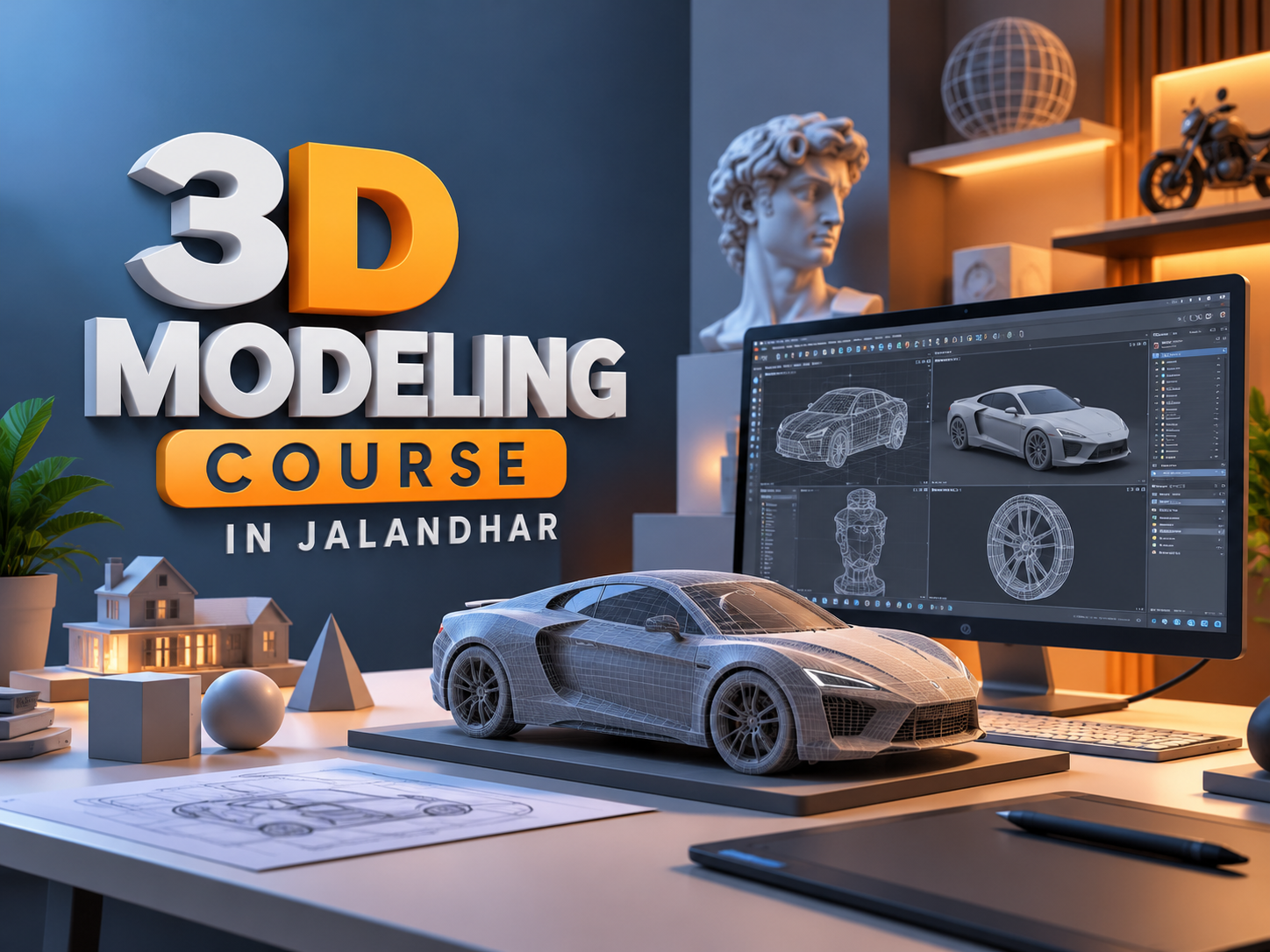
3d Modeling Course in Jalandhar
Three-dimensional modeling turns ideas into digital objects that can be viewed, adjusted, and presented from different angles. From a chair and a product package to a detailed environment, 3D models help communicate shape, proportion, construction, and appearance.
A 3D Modeling Course in Jalandhar can introduce students to the creative principles and technical processes behind these digital assets. Learning involves more than understanding software commands. It requires observation, spatial awareness, accurate measurements, and the ability to improve a model through careful review.
Students exploring this field can contact IAM Jalandhar to discuss learning goals, training requirements, and available course options. Starting with manageable exercises helps beginners develop confidence before progressing towards more complex projects.
What Is 3D Modeling?
3D modeling is the process of creating a digital representation of an object using geometry. The model exists within a three-dimensional coordinate system, allowing users to inspect its width, height, and depth.
Artists can create objects from basic forms, edit their components, and refine surfaces to achieve the required shape. The appropriate method depends on the subject and its intended use.
Common modeling projects include:
Furniture and household objects.
Interior spaces and architectural elements.
Products and packaging.
Characters and accessories.
Vehicles and mechanical props.
Environments for visual storytelling.
A model may become part of a still image, animation, interactive experience, or design presentation.
Why Learn 3D Modeling?
Learning 3D modeling helps students express ideas that may be difficult to communicate through text or flat images alone. A digital model allows viewers to examine proportions, understand spatial relationships, and compare alternatives.
For example, a furniture concept can be reviewed from several viewpoints before a physical sample is produced. An interior layout can show how objects relate within a room.
Through 3D Modeling Training in Jalandhar, learners can develop:
Spatial understanding and visual communication.
Accuracy when working with dimensions.
Creative problem-solving.
Familiarity with digital production workflows.
Observation and reference interpretation.
Practical portfolio development skills.
These abilities grow through regular practice, feedback, and completed projects.
Who Can Learn 3D Modeling?
Three-dimensional modeling can appeal to students from creative and technical backgrounds. Previous drawing or design experience may help, but beginners can start by learning navigation, simple geometry, and basic visual principles.
Potential learners include school and college students, design graduates, architecture students, aspiring digital artists, and working professionals exploring additional skills.
Students considering 3D Modeling Classes in Jalandhar should discuss prerequisites, equipment requirements, and the expected starting level.
Patience and curiosity are useful qualities. Beginners need time to understand how objects behave in three-dimensional space and why certain modeling decisions create problems. A willingness to revise work is often more helpful than rushing towards complicated projects.
Understanding the Modeling Workflow
A reliable workflow gives each project a clear direction. Before building geometry, learners should understand what needs to be created, who will view it, and how the final asset will be used.
A typical process includes:
Reading the brief and identifying requirements.
Collecting references and measurements.
Creating a simplified initial model.
Refining shapes and construction details.
Checking geometry and proportions.
Preparing surfaces for materials.
Presenting and reviewing the result.
An Introduction to 3D Modeling Course in Jalandhar should connect individual tools with this broader process. Understanding the sequence makes problems easier to identify and revisions more manageable.
Learning Software Navigation and Controls
Before attempting detailed objects, students need to become comfortable with the software workspace. Navigation controls help users inspect a model, select components, and judge relationships between objects.
Beginners should practise moving between useful viewpoints and entering numerical values where accuracy matters.
Essential skills include:
Moving, rotating, and scaling objects.
Zooming, panning, and orbiting.
Using perspective and orthographic views.
Selecting objects and their components.
Aligning elements accurately.
Managing visibility within a scene.
Learners exploring 3D Design Training in Jalandhar should repeat these operations through simple exercises. Confidence with navigation reduces frustration and makes later modeling tasks easier to understand.
Working with Scale and Proportion
Scale describes an object’s size in relation to a measurement system or surrounding elements. Proportion describes the relationship between different parts of its form.
Both influence whether a model looks convincing. A table may have an attractive shape but appear incorrect if its height does not suit the chairs around it.
Students should develop habits such as:
Setting suitable project units.
Recording important measurements.
Checking dimensions against references.
Reviewing imported objects for scale.
Comparing related parts before adding detail.
Maintaining consistency across repeated elements.
Accurate setup reduces avoidable corrections. It also supports believable materials, lighting, and presentation later in the project.
Polygon Modeling Fundamentals
Polygon modeling involves constructing and adjusting surfaces using vertices, edges, and faces. These components form the structure of many digital assets.
Beginners usually start with basic shapes and gradually develop more detailed forms through editing operations. Familiar objects make useful exercises because their proportions are easier to evaluate.
Polygon Modeling Training in Jalandhar can introduce:
Component selection and transformation.
Extrusion to extend a form.
Beveling to soften selected edges.
Adding geometry where required.
Connecting and refining surfaces.
Removing unnecessary complexity.
Students should understand the effect of each operation. Memorizing a sequence of commands without understanding the geometry makes independent problem-solving more difficult.
Topology and Clean Geometry
Topology describes how a model’s components connect. Its importance depends on how the asset will be used, particularly when surfaces need to bend, deform, or maintain a controlled appearance.
Clean geometry makes a model easier to edit and prepare for later production stages. Students should inspect unwanted intersections, duplicate surfaces, shading problems, and inconsistent connections.
More geometry does not automatically produce a better asset. Detail should support the shape, viewing distance, and intended output.
Learners should also review their models from several angles. A surface that appears correct in one view may reveal proportion or construction problems when inspected from another.
Using References Effectively
References help students understand an object’s construction, dimensions, and surface details. They reduce guesswork and encourage more informed creative decisions.
Useful sources include photographs, measured drawings, sketches, and direct observation. Multiple viewpoints often reveal details that a single image cannot show.
During 3D Modeling for Beginners in Jalandhar, students can practise:
Collecting front, side, and perspective references.
Identifying the main shapes before small details.
Comparing dimensions between related parts.
Observing how components join.
Recording reference sources.
Respecting permissions and usage conditions.
References support both realistic and stylized projects. Even an imaginative design benefits from a consistent understanding of form, balance, and construction.
Modeling Furniture and Everyday Objects
Furniture and household items offer manageable starting points. A table, cabinet, lamp, container, or shelf can introduce several techniques without requiring an overly complex scene.
Students should first identify the main forms and dimensions. Smaller details can be added after the overall proportions are correct.
A Furniture Modeling Course in Jalandhar can involve exercises such as:
Tables with consistent leg placement.
Cabinets with clear divisions.
Shelves with suitable spacing.
Chairs built from simplified forms.
Lamps with separate structural components.
Objects designed as a coordinated collection.
Each exercise should include checks for alignment, scale, geometry, and ease of revision. Completing simple objects carefully builds a useful foundation.
Interior and Architectural Modeling
Interior modeling brings several objects together within a defined space. Students need to understand room dimensions, openings, furniture placement, and circulation before adding decorative elements.
A 3D Interior Modeling Course in Jalandhar can begin with a small bedroom, study, or living room. Build the room shell first, then introduce essential furniture and selected details.
Architectural modeling may also involve exterior forms, façade elements, and surrounding features.
When exploring Architectural Modeling Training in Jalandhar, learners should work carefully from drawings and references. Visual models help communicate appearance and spatial relationships, while project execution also depends on appropriate technical documentation and professional decisions.
Introduction to Character and Organic Forms
Characters and organic objects introduce different challenges from furniture or buildings. Their shapes may require smoother transitions, more careful surface flow, and attention to anatomy or stylization.
Beginners should start with simplified forms rather than detailed characters. Understanding proportion, silhouette, and major masses provides a stronger foundation than immediately adding small features.
A Character Modeling Course in Jalandhar may involve further study of form, topology, and deformation requirements.
Students should confirm whether character work is included in the course they are considering. General modeling programmes vary in scope, and specialist character production usually requires additional practice and focused learning.
UV Mapping, Materials, and Textures
After the geometry is prepared, the model may need UV mapping so textures can be positioned across its surfaces. UVs represent the three-dimensional surface in two dimensions.
Poor mapping can produce stretched patterns, inconsistent detail sizes, or distracting seams. Students should check the entire object rather than reviewing only one viewpoint.
3D Modeling and Texturing Training in Jalandhar can introduce:
Preparing basic UV layouts.
Applying materials to selected surfaces.
Adjusting texture scale and orientation.
Managing surface roughness and reflection.
Checking consistency across related objects.
Reviewing materials under suitable lighting.
Observing real surfaces helps learners represent wood, fabric, glass, paint, and metal more convincingly.
Lighting and Presentation Basics
A model needs a clear presentation so viewers can understand its form. Lighting reveals surfaces and depth, while camera placement determines what receives attention.
Beginners should start with controlled setups that show the object accurately. Dramatic effects are easier to evaluate after the basic form is readable.
Useful checks include:
Whether the silhouette is clear.
Whether shadows hide important details.
Whether reflections distract from the object.
Whether the camera angle suits the purpose.
Whether the background supports the presentation.
Whether several views are needed.
A 3D Modeling and Rendering Course in Jalandhar can help learners connect geometry with final image production through small, carefully reviewed projects.
Scene Organization and File Management
Organized projects are easier to revise, review, and share. Even a small scene can become confusing when objects have unclear names or source files are scattered across folders.
Students should establish practical habits from the beginning:
Give objects meaningful names.
Separate related elements logically.
Maintain clear project folders.
Keep textures and references accessible.
Save versions at important stages.
Remove abandoned test objects.
Record any third-party assets used.
Good organization also helps when receiving feedback. A reviewer can understand the project more easily when its structure is clear, and students can make requested changes without searching through unnecessary files.
Practical Projects and Portfolio Development
Projects help students connect individual techniques with complete tasks. A few finished examples can demonstrate stronger understanding than many incomplete assets.
Useful portfolio projects include a furniture item, a household product, a small interior, and a coordinated collection of props. Select work that shows different skills while maintaining consistent presentation quality.
For each project, explain the objective, references, personal contribution, and revisions. Include process views where they help demonstrate the modeling work.
Clearly credit downloaded assets and supplied materials. Accurate attribution allows viewers to understand which elements the student created independently and how supporting resources contributed to the result.
Exploring Learning Options with IAM
When considering an IAM 3D Modeling Course in Jalandhar, explain your current knowledge, preferred subjects, and intended outcomes. Product assets, interiors, and characters can require different learning priorities.
Ask about software applications, practical assignments, instructor feedback, and expected independent practice. Confirm duration, batch timings, equipment requirements, and any additional software costs directly with IAM.
A suitable learning plan should connect foundational exercises with complete projects. Students should also understand which topics receive introductory coverage and which require further specialist study. Clear expectations make progress easier to assess and portfolio planning more purposeful.
Conclusion
A 3D Modeling Course in Jalandhar can provide a foundation for turning ideas into organized, believable digital assets. Progress depends on observation, accurate proportions, clean geometry, and consistent practice.
Connect with IAM Jalandhar to discuss relevant training options and learning goals. Start with manageable objects, review each stage carefully, and develop a portfolio that demonstrates technical understanding, creative judgement, and clear presentation.
Turn Creative Ideas into 3D Models with IAM Jalandhar
Explore 3D modeling with IAM Jalandhar. Expand skills in geometry, texturing and rendering, then turn your creative ideas into digital projects. Get course details today!
Tell us whatyou wantto create.
A few lines about yourself and the course you're interested in. Our admissions team replies within two working days, and you can book a free campus visit or demo class.
Call admissions→Or send an enquiry to your nearest campus- Phone
- +91 98881 22241
- Address
- 1st Floor, IAM, Crystal Plaza, SCS 78, opp. PIMS Hospital, Jalandhar, Punjab 144001