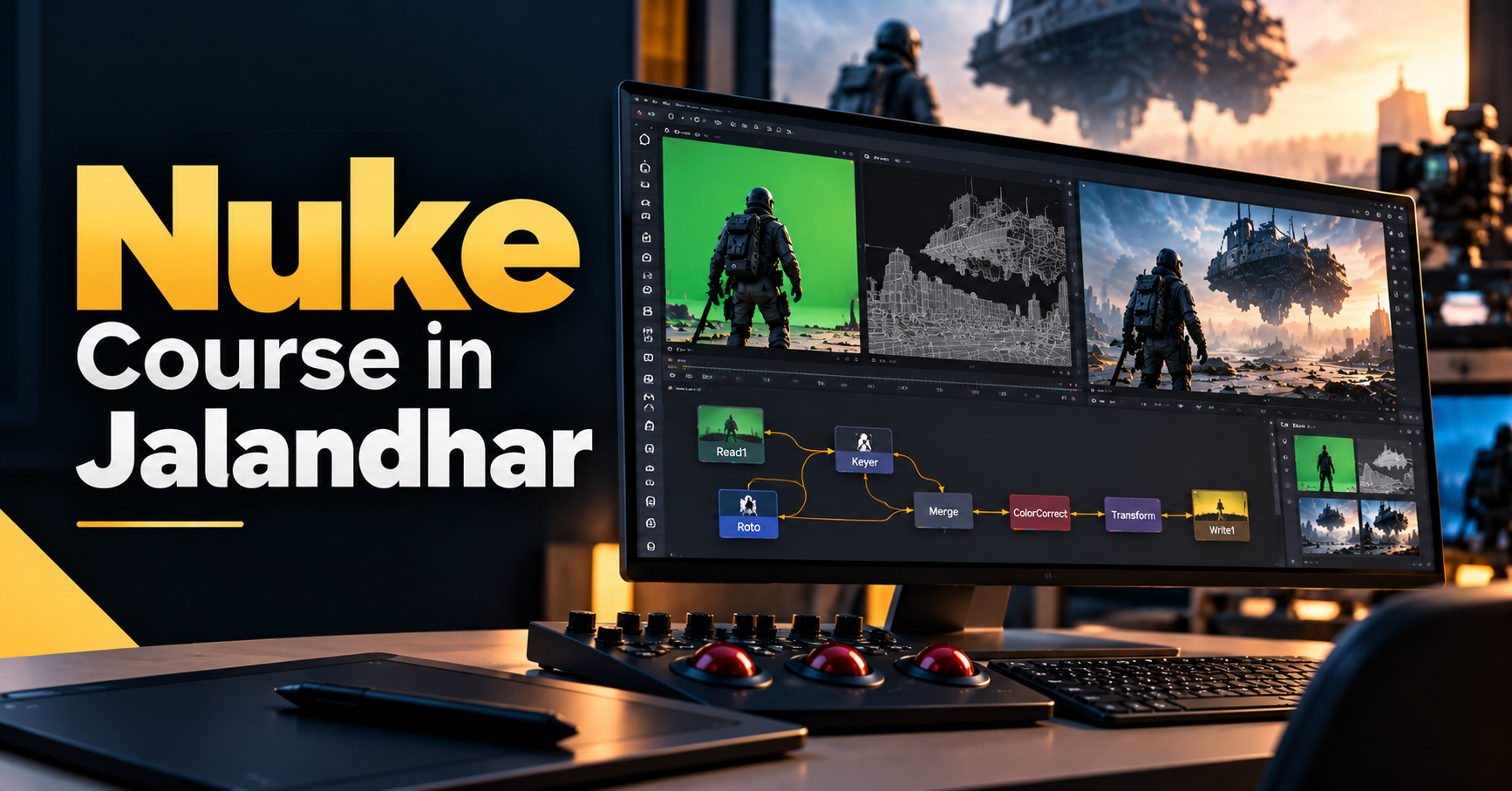
Nuke Course in Jalandhar
Nuke Course in Jalandhar
Have you ever wondered how filmmakers create invisible effects, remove unwanted objects from scenes, combine different footage, or make imaginary environments look real? Much of this work involves visual effects compositing — a creative process that brings multiple visual elements together to produce a seamless final shot.
The Nuke Course in Jalandhar at IAM (Institute of Animation and Multimedia) is a training option to explore if you are interested in digital compositing, film production, and visual effects. Nuke is a professional node-based compositing application used to combine and refine visual elements for film, television, animation, and other digital productions.
Learning Nuke can help aspiring VFX artists understand how raw footage, computer-generated elements, masks, colour adjustments, and visual effects are combined into a finished composition. Whether you are beginning your journey in multimedia or looking to expand your creative software knowledge, understanding compositing can introduce you to an important part of post-production.
Before enrolling, contact IAM to confirm the current syllabus, course duration, fees, software access, and practical project details.
What Is Foundry Nuke?
Nuke is a node-based compositing and visual effects application developed by Foundry. It allows artists to process, combine, and manipulate image sequences through a connected network of nodes.
Unlike a traditional layer-based workflow, Nuke's node graph provides a visual way to organise the operations applied to a shot. Each node performs a specific task, such as reading footage, adjusting colour, creating a mask, removing an element, or combining images.
Nuke is used for a range of compositing tasks, including green-screen keying, rotoscoping, tracking, cleanup, colour correction, and 2D or 3D compositing. These capabilities make it a useful application to understand for learners interested in professional VFX workflows.
Why Learn a Nuke Course in Jalandhar?
Visual effects are used in films, advertisements, television productions, music videos, streaming content, and digital media. Many shots require multiple elements to be combined carefully so that the final result appears natural and consistent.
Compositing artists work with footage, computer-generated imagery, lighting information, masks, and other elements to create the final visual. Learning Nuke can help you understand how these components are managed and refined.
For learners in Jalandhar, exploring Nuke training locally can provide an opportunity to develop VFX software knowledge while working towards creative goals. When comparing courses, consider the learning structure, practical assignments, instructor guidance, and opportunities to build a portfolio.
What Can You Learn in a Nuke Course?
The following topics represent common areas of Nuke compositing training. Confirm which modules are included in IAM's current programme.
1. Nuke Interface and Node-Based Workflow
Begin by understanding the Nuke interface, viewers, node graph, properties panels, and project organisation. Learn how nodes connect and how each operation contributes to the final image.
The node-based workflow is central to Nuke. By connecting operations in a logical structure, artists can create flexible compositions and revisit individual steps without rebuilding the entire project.
Understanding the interface and node connections provides a foundation for more advanced compositing tasks.
2. Compositing Fundamentals
Compositing involves combining multiple visual elements into one cohesive image or sequence. Learners can explore image inputs, alpha channels, masks, blending, and basic image operations.
For example, a foreground subject can be combined with a new background while adjusting edges, colour, and lighting to create a more convincing result.
The goal is to make the separate elements appear as though they belong in the same scene.
3. Green Screen and Keying
Green-screen keying is a common compositing technique used to separate a subject from a coloured background. Nuke includes keying tools that help artists create mattes and combine subjects with new environments.
Learning keying involves understanding colour selection, matte refinement, edge quality, spill suppression, and transparency.
Hair, motion blur, transparent materials, and uneven lighting can make keying challenging. Practice helps learners understand how to improve the result while preserving important details.
4. Rotoscoping and Masking
Rotoscoping involves creating or refining shapes around objects or subjects so they can be isolated, adjusted, or combined with other elements.
Masks can be used to control where an effect appears, protect part of an image, or separate elements within a shot.
Learners may explore spline shapes, animated masks, edge refinement, and frame-by-frame adjustments. These techniques are useful when automatic keying does not provide the desired result.
5. Tracking and Match Moving
Tracking helps artists follow the movement of points or features in footage. The resulting motion data can be used to attach visual elements to a moving object, stabilise footage, or support compositing.
Depending on the tools and course level, learners may explore 2D tracking, planar tracking, and 3D camera tracking concepts.
Tracking requires careful review because motion blur, occlusion, changing lighting, and low-detail footage can affect accuracy.
6. Cleanup and Paint Techniques
Visual effects artists often need to remove unwanted elements from footage. These may include wires, markers, small objects, or other distractions.
Cleanup workflows can involve paint tools, cloning, tracking, frame analysis, and carefully combining image information from different frames.
The objective is to remove the unwanted element while maintaining visual continuity, texture, and detail.
7. Colour Correction and Integration
When combining footage from different sources, the elements may not match in colour, contrast, brightness, or saturation.
Colour correction helps bring these elements closer together. Artists may adjust exposure, contrast, colour balance, and other image properties to improve integration.
Lighting direction, shadows, reflections, and atmospheric effects can also influence how naturally a composite appears.
8. 3D Compositing Concepts
Nuke includes a 3D environment that can support compositing workflows involving cameras, geometry, lights, and image-based elements.
Learners may explore how 2D footage and 3D elements can be positioned within a scene, depending on the course syllabus.
These concepts can be useful for tasks such as set extensions, environment integration, and combining rendered assets with live-action footage.
9. Final Composition and Output
A finished composite should be reviewed for visual consistency, edge quality, colour matching, unwanted artifacts, and overall presentation.
Preparing the final output may involve checking image dimensions, frame range, format, colour settings, and render quality.
Understanding the final review process helps learners develop a more organised approach to completing VFX shots.
Practical Projects to Explore With Nuke
Project-based practice can help learners understand how individual tools work together in a complete compositing task. Depending on IAM's course modules, possible project ideas include:
Green-Screen Composite: Separate a subject from a green background and place it into a new environment.
Object Removal: Remove an unwanted element from a short footage clip and reconstruct the background.
Rotoscoping Exercise: Create and refine masks around a moving subject.
Screen Replacement: Track a surface and composite new visual content onto it.
Colour Matching Project: Adjust foreground and background elements to create a cohesive shot.
Basic 3D Composite: Explore how a 3D element can be integrated with footage.
VFX Shot Breakdown: Document the original footage, compositing steps, and final result.
These are illustrative project ideas, not a confirmed list of IAM assignments. Ask the institute which practical projects are included and whether learners can use suitable completed work in a portfolio.
Who Can Learn Nuke?
A Nuke course may interest students, aspiring VFX artists, animation learners, video editors, and creative individuals who want to explore compositing.
Beginners can start by learning the interface and basic compositing concepts before progressing to more complex workflows. Existing knowledge of animation, 3D software, photography, or video editing may be useful, but the entry requirements depend on the specific programme.
If you are considering a course, ask IAM whether it is suitable for beginners, what prior knowledge is recommended, and how much time is dedicated to practical exercises.
Career Opportunities Related to Nuke Skills
Nuke knowledge can support exploration of several creative roles. Career opportunities depend on your practical ability, portfolio, experience, additional software knowledge, and employer requirements.
Potential career paths include:
Compositing Artist: Combines visual elements into a seamless final shot.
Roto Artist: Creates and refines masks to isolate subjects or objects.
Paint and Cleanup Artist: Removes unwanted elements and repairs footage.
Keying Artist: Works with green-screen and blue-screen footage.
Matchmove Artist: Tracks camera or object movement for VFX integration.
Junior VFX Artist: Supports compositing and visual effects production tasks.
Freelance Compositor: Works on suitable compositing projects for clients.
Learning Nuke alone does not guarantee a job. Building a strong showreel, practising shot breakdowns, understanding visual storytelling, and developing problem-solving skills are important steps towards preparing for relevant opportunities.
Why Consider IAM for Nuke Training in Jalandhar?
If you are searching for a Nuke course in Jalandhar, IAM (Institute of Animation and Multimedia) is an institute to contact for details about its available training options.
Before enrolling, ask about the course syllabus, training duration, practical assignments, software access, instructor support, fees, class schedule, and portfolio guidance.
It is also useful to understand whether the programme focuses on foundational compositing, advanced VFX techniques, or a combination of different topics. A clear overview of the course can help you decide whether it matches your interests and learning goals.
Start Exploring Visual Effects Compositing
Nuke provides a node-based approach to compositing and visual effects, allowing artists to combine, refine, and manage visual elements in a structured workflow.
If you want to explore digital compositing, green-screen work, rotoscoping, tracking, cleanup, and VFX integration, enquire about the Nuke Course in Jalandhar at IAM (Institute of Animation and Multimedia).
Contact IAM to confirm the current syllabus, course duration, fees, practical training, and admission details.
Take the next step towards exploring compositing and visual effects. Get in touch with IAM Jalandhar to learn more about Nuke training.
Create Seamless Visual Effects With Nuke
Explore node-based compositing, green-screen keying, rotoscoping, tracking, cleanup, and visual effects workflows with the Nuke Course in Jalandhar at IAM.
Tell us whatyou wantto create.
A few lines about yourself and the course you're interested in. Our admissions team replies within two working days, and you can book a free campus visit or demo class.
Call admissions→Or send an enquiry to your nearest campus- Phone
- +91 98881 22241
- Address
- 1st Floor, IAM, Crystal Plaza, SCS 78, opp. PIMS Hospital, Jalandhar, Punjab 144001