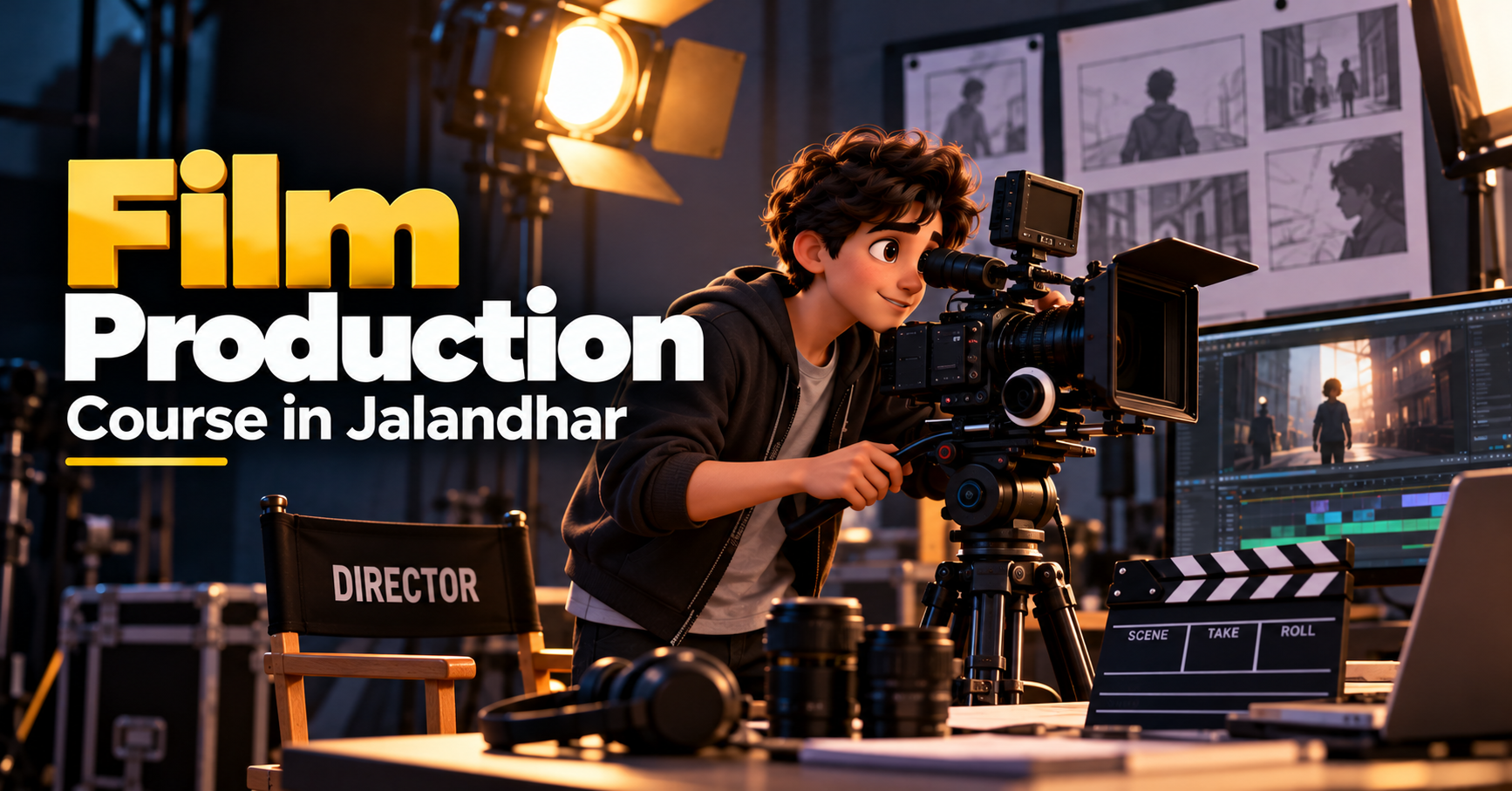
Film Production Course in Jalandhar
Film Production Course in Jalandhar – Turn Your Vision into Cinema at IAM
A powerful film can make people laugh, think, feel, and see the world differently. But behind every memorable scene is a creative process involving ideas, planning, cameras, sound, lighting, and editing.
The Film Production Course in Jalandhar at IAM – Institute of Animation and Multimedia is for aspiring filmmakers, visual storytellers, and creative learners who want to explore how films and video content are made. From developing a story concept to planning a shoot and shaping the final edit, film production brings multiple creative disciplines together.
Whether your interest lies in filmmaking, short films, music videos, documentaries, or digital video content, understanding the production process can help you explore the world behind the camera.
Every Film Begins with a Story
Before a camera starts recording, there is an idea.
It might be a character facing a difficult decision, a real-life story worth sharing, or a visual concept that needs to be brought to life. Film production begins by developing that idea into a story that can be communicated through images, sound, and movement.
A filmmaker considers more than just what happens in a scene. They also think about how the audience will experience it.
What should the audience see?
What emotion should the scene create?
How should the camera capture the moment?
What role will sound and lighting play?
How will the scene connect with the next one?
These decisions form the foundation of visual storytelling.
The Filmmaking Journey: From Concept to Screen
Film production is a collaborative process. Each stage contributes to the final experience, and understanding how these stages connect can help learners develop a broader perspective on filmmaking.
Stage 1: Pre-Production – Plan Before You Shoot
Pre-production is where a film begins to take shape. Ideas are developed, scenes are planned, and practical decisions are made before filming begins.
This stage may involve:
Story development and concept planning
Scriptwriting fundamentals
Screenplay structure
Storyboarding
Shot planning
Location scouting
Production scheduling
Basic budgeting and resource planning
A well-planned production can help the team understand what needs to be captured and how to organize the shoot efficiently.
Stage 2: Production – Capture the Story
Production is the stage where planned scenes are filmed. The crew works together to capture performances, visuals, and sound according to the creative direction.
The process may introduce learners to:
Camera operation: Understanding camera controls, framing, focus, and recording fundamentals.
Shot composition: Exploring how camera angles, shot sizes, and visual arrangement influence storytelling.
Lighting: Using light and shadow to establish mood, depth, and atmosphere.
Directing: Communicating ideas, guiding performances, and coordinating creative decisions.
Location and set preparation: Considering the environment, background, props, and practical requirements of a scene.
Production sound: Understanding the importance of recording clear dialogue and useful audio during filming.
The goal is to capture visuals and sound that support the story.
Stage 3: Cinematography – Think in Frames
Cinematography is the visual language of filmmaking. It shapes how a story looks and how the audience interprets what they see.
A filmmaker may use a wide shot to establish a location, a close-up to highlight emotion, or a low camera angle to create a particular impression.
Cinematography involves creative decisions related to:
Camera angles and shot sizes
Framing and composition
Camera movement
Lens and perspective concepts
Lighting techniques
Visual continuity
Colour and mood
Understanding these elements can help learners communicate stories visually rather than relying only on dialogue.
Stage 4: Directing – Shape the Performance
Directing brings the creative vision of a film together. Directors work with actors, camera teams, and other crew members to create a consistent storytelling experience.
Directing may involve:
Interpreting a script
Planning scenes
Guiding actors and performances
Communicating creative ideas
Blocking scenes
Coordinating camera and visual decisions
Maintaining the story’s tone
A director helps ensure that the individual parts of a production work toward a shared creative purpose.
Stage 5: Post-Production – Shape the Final Story
Filming is only one part of the filmmaking process. After the shoot, the recorded material is organized, refined, and assembled into the final production.
Post-production may include:
Video editing
Selecting and arranging shots
Creating scene transitions
Dialogue editing
Sound effects and music integration
Colour correction fundamentals
Titles and credits
Exporting the final video
Editing can change the pace, emotion, and meaning of a scene. The right sequence of shots can make a story feel dramatic, exciting, emotional, or suspenseful.
Stage 6: Film Presentation and Distribution
Once a film is complete, it needs to reach its intended audience. Different projects may be prepared for film festivals, online platforms, television, social media, or other distribution channels.
Learners can explore concepts such as:
Preparing a final video
Understanding common output formats
Basic presentation planning
Film promotion fundamentals
Audience and platform considerations
Knowing how a project will be presented can influence creative and technical decisions throughout production.
The Creative Roles Behind a Film
A film is rarely created by one person working alone. Different professionals contribute their skills to bring a production together.
Role
Creative Contribution
Director
Shapes the creative vision and guides the film
Screenwriter
Develops the story and screenplay
Cinematographer
Plans and captures the visual language
Camera Operator
Operates the camera during filming
Production Designer
Helps shape the visual environment
Editor
Assembles footage into the final story
Sound Designer
Develops the film’s sound experience
Producer
Coordinates production resources and planning
Exploring these roles can help learners understand which parts of filmmaking match their interests.
Create a Film, Not Just a Practice Exercise
Practical projects can help learners connect creative ideas with production decisions. A short film project, for example, may involve developing a story, preparing a script, planning shots, filming scenes, and editing the final sequence.
Possible project formats to explore include:
Short narrative films
Documentary-style videos
Interviews
Music videos
Promotional videos
Short-form digital content
Visual storytelling exercises
The exact projects and practical assignments offered by IAM should be confirmed with the institute.
A completed project can also become part of a learner’s portfolio, demonstrating their creative approach, technical understanding, and ability to contribute to a production.
Who Is Film Production For?
Film production may appeal to people who enjoy storytelling, visual creativity, collaboration, and working with cameras or editing tools.
It may be worth exploring if you are:
A beginner curious about filmmaking
A student interested in media and entertainment
A creative person who enjoys telling stories
Interested in directing or cinematography
A video content creator
Interested in editing and post-production
Curious about how films and digital videos are produced
You do not need to have already made a film to begin exploring the subject. An interest in storytelling and a willingness to learn can be a useful starting point.
Film Production and the Digital Content World
Filmmaking techniques are used far beyond cinema. Businesses, creators, educational platforms, and digital media teams also rely on video to communicate ideas.
Film production concepts can be relevant to:
Short films and independent filmmaking
Video content creation
Advertising and promotional videos
Documentary production
Music videos
Corporate videos
Digital media production
Video editing and post-production
The skills required vary across roles and projects. Building experience through practice and developing a portfolio can help learners explore their preferred direction.
Explore Film Production at IAM Jalandhar
Filmmaking combines creative thinking with technical execution. Learning about storytelling, camera work, lighting, sound, directing, and editing can help you understand how a production moves from an idea to a finished visual experience.
At IAM – Institute of Animation and Multimedia, Jalandhar, you can enquire about the Film Production Course and explore how it aligns with your creative interests.
Before enrolling, ask IAM about the current syllabus, practical projects, equipment and software used, course duration, fees, batch timings, and admission requirements.
Your Story Could Be the Next One on Screen
Every filmmaker starts somewhere—with a story, a scene, or a simple idea they want to share.
Explore the Film Production Course in Jalandhar at IAM – Institute of Animation and Multimedia and discover the creative process behind filmmaking, from planning and shooting to editing and final presentation.
Contact IAM to learn more about the course and admission details.
From the First Frame to the Final Cut
Explore storytelling, cinematography, camera techniques, lighting, directing, and video editing with the Film Production Course in Jalandhar at IAM.
Tell us whatyou wantto create.
A few lines about yourself and the course you're interested in. Our admissions team replies within two working days, and you can book a free campus visit or demo class.
Call admissions→Or send an enquiry to your nearest campus- Phone
- +91 98881 22241
- Address
- 1st Floor, IAM, Crystal Plaza, SCS 78, opp. PIMS Hospital, Jalandhar, Punjab 144001