Compositing Course in Ludhiana
Compositing Course in Ludhiana
Compositing is one of the most important stages of modern film, animation, VFX, and digital content production. It brings together different visual elements such as live-action footage, 3D renders, green-screen footage, backgrounds, effects, graphics, and digitally created assets to produce a seamless final shot. With the growing demand for high-quality visual content in films, advertisements, OTT platforms, music videos, and digital media, compositing has become a valuable creative and technical skill.
A professional Compositing Course in Ludhiana can help students understand how individual visual elements are combined to create realistic and visually impressive scenes. The course focuses on both artistic understanding and technical skills, allowing learners to develop professional compositing workflows and create portfolio-ready projects.
What is Compositing?
Compositing is the process of combining multiple visual elements into a single final image or video sequence. These elements may come from different sources, including cameras, 3D software, animation programs, stock footage, and visual effects applications.
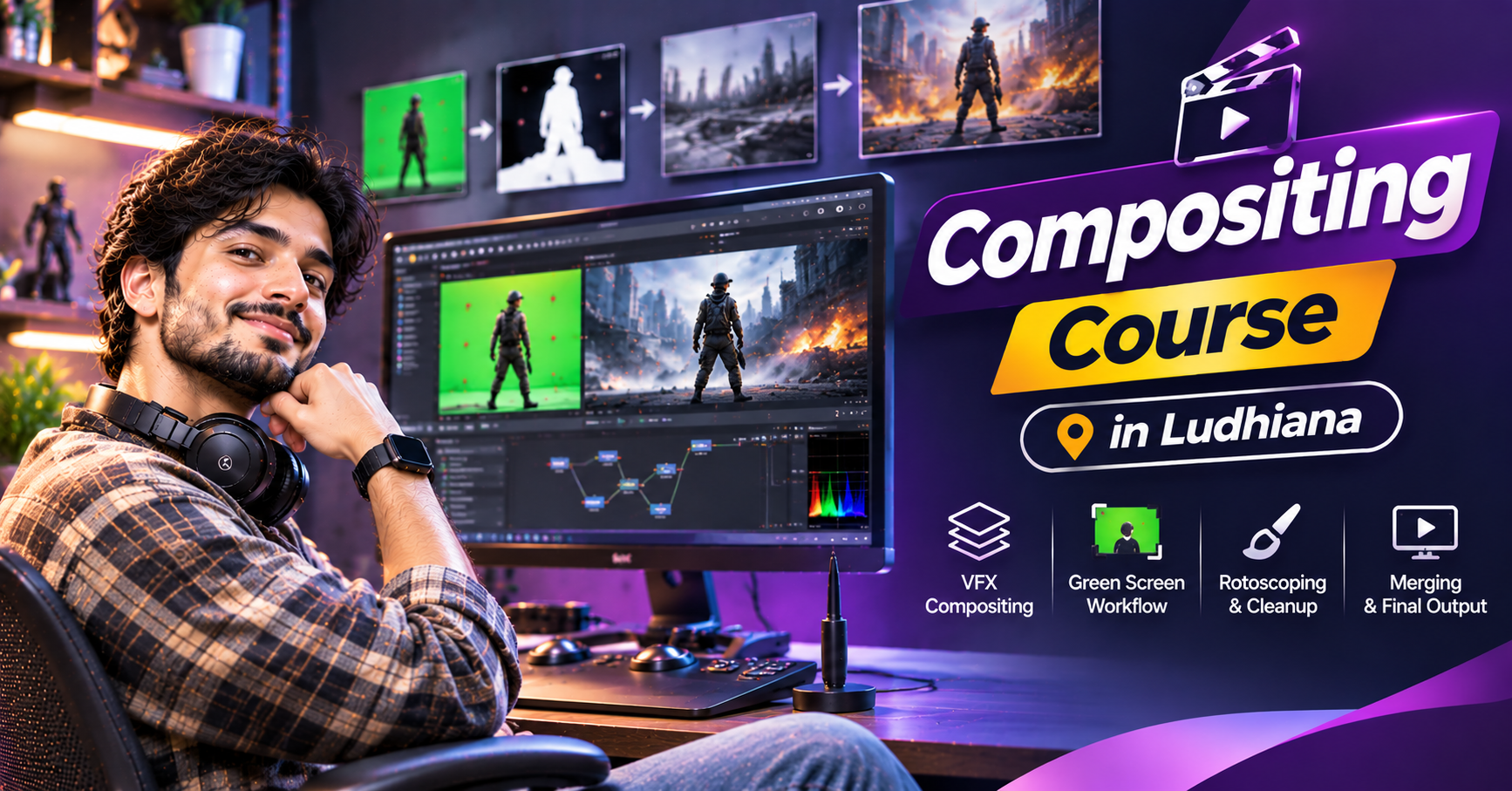
For example, a filmmaker may shoot an actor in front of a green screen and later replace the green background with a digitally created environment. A compositor ensures that the actor, background, lighting, shadows, colours, and effects appear as if they were captured together.
A Compositing Course in Ludhiana teaches students how to perform these tasks using professional techniques and industry-standard software.
Why Choose a Compositing Course in Ludhiana?
Ludhiana is an important educational and commercial city in Punjab, with increasing opportunities in creative design, digital marketing, media, advertising, animation, and video production. As businesses and content creators increasingly depend on visual communication, skilled VFX and compositing professionals can find opportunities across different industries.
Choosing a Compositing Course in Ludhiana allows students to develop specialized skills while building a strong creative portfolio. Instead of learning only basic editing, students can focus on advanced visual production techniques used to create realistic and cinematic results.
Compositing can also complement skills in animation, VFX, filmmaking, 3D design, and video editing.
What Do You Learn in a Compositing Course?
A comprehensive Compositing Course in Ludhiana can introduce students to several important concepts and techniques.
Green Screen and Chroma Keying
Green-screen compositing is one of the most widely used techniques in visual effects. Students learn how to remove a green or blue background and replace it with another environment.
The process requires careful attention to edges, hair details, shadows, lighting, spill, and colour differences. Students learn how to make the inserted background look naturally integrated with the subject.
Rotoscoping
Rotoscoping involves manually or digitally isolating objects or subjects from footage. It is commonly used when a green screen is unavailable or when specific elements need to be separated from a scene.
Students can learn techniques for creating masks, tracking moving subjects, refining edges, and maintaining accurate selections throughout a sequence.
Keying
Keying is an important part of compositing. It allows artists to isolate specific colour ranges from footage and replace or manipulate them.
Students learn how to create clean keys while dealing with challenges such as uneven backgrounds, motion blur, transparent objects, fine hair, and colour spill.
Masking and Layer Management
Professional compositing involves working with multiple layers and visual elements. Students learn how to create masks, organize layers, control transparency, and combine different assets effectively.
Understanding layer-based workflows helps artists maintain organized projects and make changes efficiently during production.
Tracking and Matchmoving
Tracking allows digital elements to follow the movement of objects or cameras within footage. Students learn basic tracking techniques to ensure that graphics, effects, or backgrounds remain correctly positioned.
Matchmoving can be particularly important when integrating 3D objects into live-action footage. The goal is to make digital elements appear naturally connected to the original camera movement.
Colour Correction and Colour Grading
Colour plays a major role in creating believable composites. If two elements have different colour temperatures, contrast levels, or exposure, they may appear disconnected.
Students learn colour correction techniques to match different elements and create visual consistency across the shot.
They can also learn how lighting, shadows, highlights, contrast, saturation, and colour temperature influence realism.
Matte Creation
Mattes define which parts of an image should be visible, hidden, or affected by an effect. Creating accurate mattes is an essential compositing skill.
Students learn how to create and refine mattes for different visual elements while maintaining clean edges and natural transitions.
VFX Integration
Compositing is often the final stage where different VFX elements come together. Students can learn how to integrate explosions, smoke, fire, particles, atmospheric effects, digital environments, and other visual elements into footage.
The objective is to make the effects look naturally connected to the scene.
Software Used in Compositing
A professional Compositing Course in Ludhiana may introduce students to industry-relevant software depending on the curriculum.
Common tools include:
Adobe After Effects
Nuke
Mocha
Silhouette
3D Equalizer
Photoshop
Blender
Maya
Other VFX and compositing tools
Each application has different strengths and workflows. For example, After Effects is widely used for motion graphics and compositing, while Nuke is strongly associated with professional film and VFX workflows.
Learning multiple tools can help students understand different production pipelines.
Compositing for Film and VFX
Compositing plays a major role in filmmaking and visual effects. Many scenes seen in films are created by combining real footage with digitally generated elements.
A compositor may work on tasks such as:
Green-screen replacement
Set extensions
Digital environments
Sky replacement
Object removal
Wire removal
CG integration
Atmospheric effects
Fire and smoke integration
Background replacement
Screen replacement
Colour matching
These techniques allow filmmakers to create environments and sequences that may not be practical to capture entirely in-camera.
Compositing for Advertising
Advertising agencies also use compositing to create visually attractive campaigns. Product advertisements often combine photography, 3D models, backgrounds, motion graphics, and visual effects.
A trained compositor can help create product visuals, promotional videos, social media advertisements, cinematic brand content, and creative campaigns.
This makes compositing a useful skill not only for film and television but also for digital marketing and advertising.
Who Can Join a Compositing Course?
A Compositing Course in Ludhiana can be suitable for students and professionals interested in visual effects and digital production.
It may be useful for:
Students after 12th
Animation students
VFX students
Video editors
Graphic designers
3D artists
Filmmaking students
Motion graphics artists
Digital content creators
Aspiring VFX professionals
Students do not necessarily need advanced technical knowledge to begin. A basic understanding of computers and an interest in visual storytelling can provide a good starting point.
Importance of Practical Projects
Compositing is a hands-on skill, so practical training is extremely important. Students should get opportunities to work on real-world-style projects rather than learning only through theoretical lessons.
Projects may include:
Green-screen shots
Background replacement
Rotoscoping exercises
Product compositing
Screen replacement
VFX integration
Cinematic environment creation
Colour matching
Motion tracking
CG integration
These projects help students understand the complete workflow and develop confidence with professional tools.
Build a Professional Compositing Portfolio
A strong portfolio is essential for creative professionals. Students completing a Compositing Course in Ludhiana should showcase their best work through before-and-after shots, breakdowns, final composites, and short video sequences.
A good portfolio can demonstrate skills such as keying, rotoscoping, tracking, colour correction, masking, CG integration, and VFX compositing.
Employers and clients can use a portfolio to evaluate the practical abilities of an artist, making it an important part of career preparation.
Career Opportunities After a Compositing Course
After completing a Compositing Course in Ludhiana, students can explore various creative career paths depending on their specialization and portfolio.
Potential roles include:
Compositor
VFX Compositor
Junior Compositor
Rotoscopy Artist
Keying Artist
Paint Artist
Matchmove Artist
VFX Artist
Motion Graphics Artist
Video Compositor
Post-Production Artist
Professionals may find opportunities with VFX studios, animation companies, advertising agencies, production houses, post-production studios, gaming companies, and digital media organizations.
Freelancing can also provide opportunities to work with clients on advertisements, promotional videos, music videos, social media content, and other digital projects.
Future Scope of Compositing
As visual content continues to grow across films, streaming platforms, advertising, social media, gaming, and digital marketing, the need for professionals who can create polished visual content remains important.
The field is also evolving with artificial intelligence, real-time rendering, virtual production, and advanced visual effects technologies. Learning traditional compositing fundamentals alongside emerging technologies can help students adapt to changing production workflows.
Conclusion
A Compositing Course in Ludhiana can provide students with the technical and creative foundation required to work in the VFX and post-production industry. From green-screen keying and rotoscoping to tracking, colour correction, matte creation, and CG integration, students can learn how different visual elements are transformed into a seamless final shot.
With practical projects, professional software training, and a strong portfolio, learners can prepare for opportunities in VFX studios, filmmaking, advertising, animation, digital media, and freelance production.
If you are passionate about visual effects and want to learn how cinematic shots are created by combining multiple visual elements, a Compositing Course in Ludhiana can be an excellent starting point for developing your creative and technical career.
Compositing Course in Ludhiana
Learn professional compositing with a Compositing Course in Ludhiana. Master keying, rotoscoping, masking, tracking, colour correction, VFX integration and industry tools like Nuke and After Effects. Create realistic visual effects, work on practical projects and build a strong portfolio.
Tell us whatyou wantto create.
A few lines about yourself and the course you're interested in. Our admissions team replies within two working days, and you can book a free campus visit or demo class.
Call admissions→Or send an enquiry to your nearest campus- Phone
- +91 98881 22241
- Address
- 1st Floor, IAM, Crystal Plaza, SCS 78, opp. PIMS Hospital, Jalandhar, Punjab 144001