Compositing Course in Amritsar
Compositing Course in Amritsar
The visual effects and post-production industry is growing rapidly with the increasing demand for films, OTT content, advertisements, music videos, social media videos, animation, and digital media. Behind many of the impressive visual sequences seen on screen is the work of skilled compositors who combine multiple visual elements into a seamless final shot.
A Compositing Course in Amritsar can help students develop the technical and creative skills required to enter the VFX and post-production industry. From green-screen keying and rotoscoping to tracking, colour correction, masking, and CG integration, compositing teaches students how different visual elements can be brought together to create realistic and cinematic results.
What is Compositing?
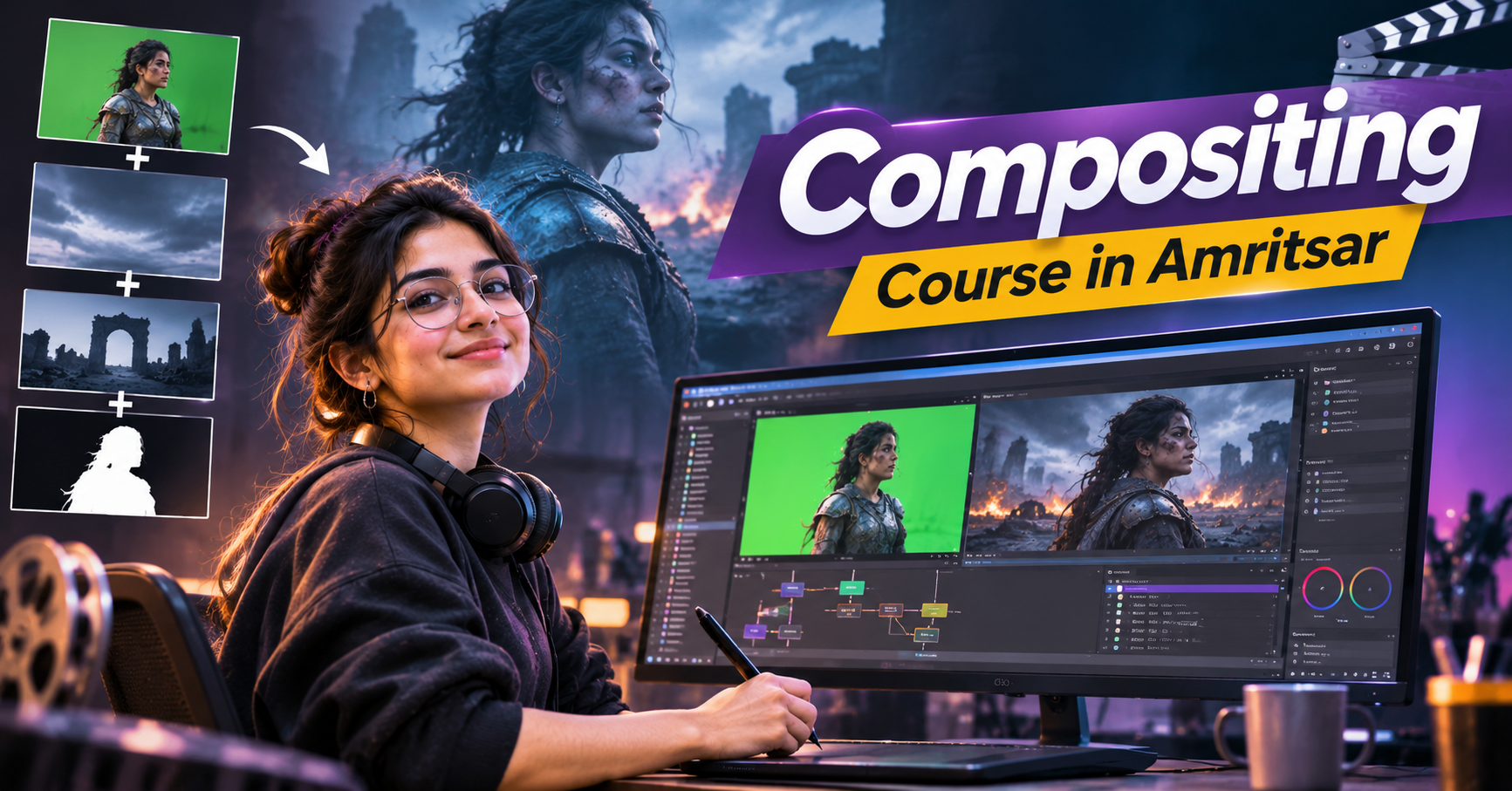
Compositing is the process of combining two or more visual elements into a single image or video sequence. These elements can include live-action footage, 3D renders, photographs, animations, backgrounds, graphics, particles, and special effects.
For example, an actor may be filmed in front of a green screen and later placed inside a digitally created environment. A compositor combines the actor with the background while matching colour, lighting, shadows, perspective, and movement to make the final scene look believable.
A professional Compositing Course in Amritsar teaches students the techniques and workflows used to perform these tasks effectively.
Why Choose a Compositing Course in Amritsar?
Amritsar is an important cultural, educational, and commercial centre in Punjab. With the growing popularity of digital content, advertising, filmmaking, social media, and online platforms, creative skills are becoming increasingly valuable.
A Compositing Course in Amritsar can provide aspiring artists with an opportunity to specialize in one of the important areas of the VFX pipeline. Instead of learning only basic video editing or graphic design, students can develop specialized skills for creating and integrating visual effects.
Compositing can also complement other creative skills such as animation, 3D modeling, filmmaking, video editing, motion graphics, and VFX.
What Do You Learn in a Compositing Course?
A comprehensive Compositing Course in Amritsar can cover a wide range of techniques used in professional post-production.
Green Screen and Chroma Keying
Green-screen compositing is one of the most commonly used VFX techniques. Students learn how to remove green or blue backgrounds and replace them with digital environments or other footage.
The process requires more than simply removing a colour. Students learn how to deal with uneven lighting, hair details, motion blur, shadows, reflections, and colour spill.
The objective is to create a clean extraction that can be integrated naturally into a new environment.
Rotoscoping
Rotoscoping involves isolating subjects or objects from footage using masks and mattes. It becomes particularly useful when a green screen is unavailable or when specific parts of a shot need to be separated.
Students learn how to create accurate masks, animate them across frames, refine edges, and prepare isolated elements for compositing.
Rotoscopy is an essential skill for students who want to build a career in professional VFX and compositing.
Masking
Masking allows artists to control which areas of an image or video are visible. Students learn how to create and animate masks around different objects and subjects.
Proper masking is important when combining multiple layers because inaccurate masks can create visible edges and unrealistic results.
Motion Tracking
Tracking allows digital elements to follow the movement of objects or cameras in a video.
Students learn basic tracking concepts and how tracking data can be used to attach graphics, effects, screens, or other visual elements to moving footage.
For example, a digital advertisement can be placed on a moving billboard or a visual effect can be attached to a moving object.
Matchmoving
Matchmoving is used to recreate camera movement in a 3D environment so that digital objects can be integrated into live-action footage.
Students can learn how camera movement, perspective, and scene information influence the placement of 3D elements.
This skill can be particularly useful when working on advanced VFX projects.
Colour Correction and Matching
Different visual elements often come from different sources. Their colour, brightness, contrast, and exposure may not match.
Students learn how to adjust these properties so that multiple layers appear as though they were captured under the same lighting conditions.
Colour matching is essential for creating realistic composites.
CG Integration
Modern compositing often involves combining computer-generated elements with live-action footage.
Students can learn how to integrate 3D renders, digital objects, environments, particles, and effects into real footage.
This includes understanding shadows, reflections, atmospheric depth, lighting, colour, and perspective.
Software Used in Compositing
A professional Compositing Course in Amritsar may include different software applications depending on the curriculum and specialization.
Commonly used tools can include:
Adobe After Effects
Nuke
Mocha
Silhouette
3D Equalizer
Photoshop
Blender
Maya
After Effects is widely used for motion graphics and compositing, while Nuke is commonly associated with professional film and VFX workflows.
Learning professional software alongside fundamental compositing concepts helps students understand how different tools fit into a production pipeline.
Compositing for Films and OTT Content
Compositing plays an important role in modern filmmaking. Many scenes are created by combining live-action footage with digitally generated elements.
A compositor may work on:
Green-screen replacement
Digital environments
Set extensions
Sky replacement
Object removal
Wire removal
Screen replacement
CG integration
Smoke and fire effects
Atmospheric effects
Character integration
OTT platforms and digital video services have also increased the demand for visually engaging content, creating more opportunities for professionals with specialized VFX skills.
Compositing for Advertising and Digital Marketing
Compositing is also widely used in advertising. Brands often require visually impressive product videos and promotional campaigns.
A product can be photographed or rendered separately and then placed into a digitally created environment. Backgrounds, lighting effects, particles, typography, and animations can be added during post-production.
This makes compositing useful for advertising agencies, production companies, digital marketing teams, and content creators.
Who Can Join a Compositing Course?
A Compositing Course in Amritsar can be suitable for a wide range of learners.
It can be useful for:
Students after 12th
Animation students
VFX students
Video editors
Graphic designers
3D artists
Filmmaking students
Motion graphics designers
Content creators
Aspiring VFX professionals
Students do not necessarily need advanced technical knowledge to begin. Basic computer skills, creativity, patience, and an interest in visual storytelling can provide a good foundation.
Importance of Practical Training
Compositing is a practical skill, and students need hands-on experience to understand how different techniques work together.
A good Compositing Course in Amritsar should include practical assignments and projects that simulate real production requirements.
Students may work on projects involving:
Green-screen keying
Rotoscoping
Motion tracking
Background replacement
Screen replacement
Product compositing
Colour matching
CG integration
VFX effects
Cinematic scene creation
These projects can help students improve both technical accuracy and creative decision-making.
Build a Professional Compositing Portfolio
A portfolio is extremely important for creative professionals. Students should showcase their best work instead of simply listing software names on a resume.
A compositing portfolio can include before-and-after comparisons, final shots, breakdowns, green-screen extractions, tracking projects, CG integration, and VFX compositions.
Portfolio projects allow employers and clients to see what a student can actually create.
A well-presented portfolio can support applications for internships, jobs, freelance projects, and other creative opportunities.
Career Opportunities After a Compositing Course
After completing a Compositing Course in Amritsar, students can explore different career roles depending on their skills and specialization.
Potential career options include:
Compositor
VFX Compositor
Junior Compositor
Rotoscopy Artist
Keying Artist
VFX Artist
Matchmove Artist
Paint Artist
Motion Graphics Artist
Post-Production Artist
Professionals may work with VFX studios, animation companies, advertising agencies, film production houses, post-production studios, gaming companies, and digital media organizations.
Freelancing is another possible path, allowing skilled artists to work on advertisements, music videos, social media campaigns, promotional videos, and other digital projects.
Future Scope of Compositing
The creative industry continues to evolve with artificial intelligence, virtual production, real-time rendering, advanced 3D technologies, and new VFX workflows.
While technology is changing how visual content is produced, fundamental compositing skills remain important. Understanding masks, layers, colour, lighting, tracking, perspective, and visual integration gives artists a strong foundation that can be applied to different tools and workflows.
Students who combine compositing with VFX, 3D, animation, video editing, and emerging AI technologies can develop a broader creative skill set.
Conclusion
A Compositing Course in Amritsar can help students build specialized skills for the VFX and post-production industry. From green-screen keying and rotoscoping to tracking, colour correction, masking, and CG integration, students can learn how professional visual elements are combined to create seamless final shots.
With practical training, industry-relevant software, creative projects, and a strong portfolio, learners can prepare for opportunities in filmmaking, VFX, advertising, animation, OTT content, digital media, and freelance production.
If you are passionate about visual effects and want to learn how cinematic scenes are created by combining real footage with digital elements, a Compositing Course in Amritsar can be a strong starting point for your creative career.
Compositing Course in Amritsar | Learn VFX Compositing
Learn compositing in Amritsar with practical VFX training. Master Nuke, After Effects, keying, rotoscoping, tracking and build a professional portfolio.
Tell us whatyou wantto create.
A few lines about yourself and the course you're interested in. Our admissions team replies within two working days, and you can book a free campus visit or demo class.
Call admissions→Or send an enquiry to your nearest campus- Phone
- +91 98881 22241
- Address
- 1st Floor, IAM, Crystal Plaza, SCS 78, opp. PIMS Hospital, Jalandhar, Punjab 144001