
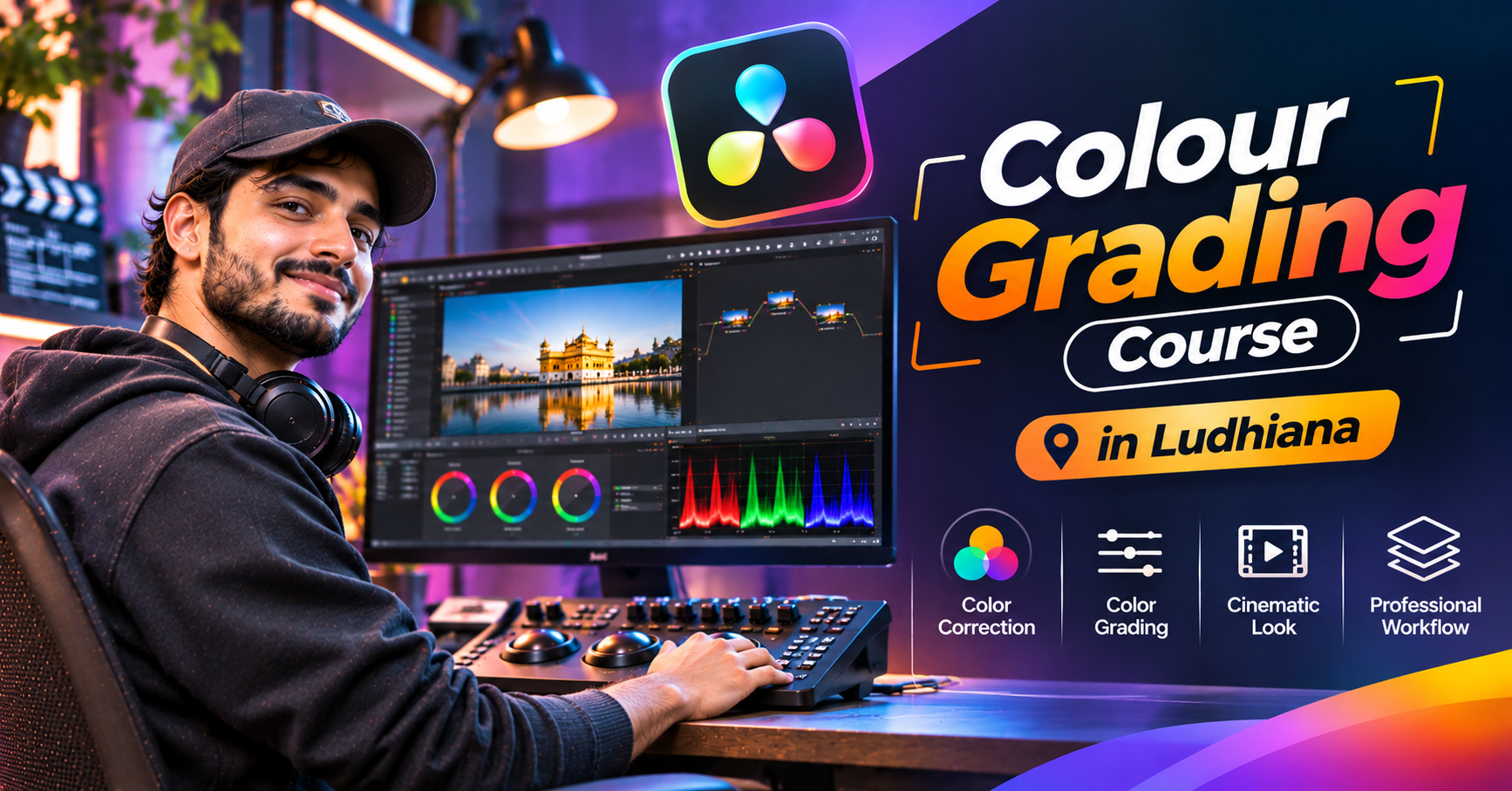
Colour Grading Course in Ludhiana
Colour Grading Course in Ludhiana: Master the Art of Cinematic Colour
Every frame you watch on screen, from a Bollywood blockbuster to a viral Instagram Reel, owes much of its mood to colour. A warm golden tone can make a scene feel nostalgic, while a cold teal shade can make it feel tense. This invisible craft is called colour grading, and it has become one of the most in-demand skills in video production. If you are looking for a Colour Grading Course in Ludhiana, this guide will help you understand what the skill involves, why it matters, and how to choose the right training.
What Is Colour Grading?
Colour grading is the process of enhancing, correcting, and stylising the colours of video footage during post-production. It has two main parts:
Colour correction fixes technical problems. This includes balancing exposure, adjusting white balance, correcting skin tones, and making sure shots from different cameras match.
Colour grading is the creative step. Here you give the footage a distinct look, such as a vintage film feel, a moody thriller palette, or a bright, vibrant commercial style.
A good Colour Grading Course in Ludhiana teaches both, because one cannot work well without the other.
Why Colour Grading Matters Today
Video content is everywhere. Wedding films, YouTube channels, music videos, short films, advertisements, web series, and brand reels all compete for attention. Footage that looks flat and washed out gets scrolled past, while polished, well-graded footage holds viewers longer and looks more professional.
For editors and filmmakers, colour grading offers several advantages:
Higher-paying work: Colourists are specialists, and specialists typically charge more than general editors.
Better client impressions: A graded video looks premium, which helps you win repeat clients.
Creative control: You shape the emotion of a story through colour.
Freelance opportunities: Studios, agencies, and creators worldwide outsource grading work.
Ludhiana, with its thriving wedding industry, growing Punjabi music scene, active content creators, and busy business community, creates steady demand for skilled video professionals. This makes a Colour Grading Course in Ludhiana a practical investment for local learners.
What You Will Learn in a Colour Grading Course
A well-structured course moves from fundamentals to advanced techniques. Here is what a quality programme typically covers.
1. Colour Theory Basics
You begin with the colour wheel, complementary and analogous colours, warm versus cool tones, saturation, hue, and luminance. Understanding why certain colours feel the way they do is the foundation of all grading decisions.
2. Software Training
Most professional courses focus on industry-standard tools:
DaVinci Resolve: The leading choice for professional colour grading, with a powerful free version.
Adobe Premiere Pro (Lumetri Color): Popular among editors who want to grade within their editing workflow.
Adobe After Effects and Final Cut Pro: Useful for specific projects and workflows.
3. Understanding Scopes
Professional colourists do not trust their eyes alone. You learn to read waveforms, vectorscopes, histograms, and RGB parades to judge exposure and colour accurately.
4. Primary and Secondary Grading
Primary grading adjusts the whole image using lift, gamma, gain, and offset controls. Secondary grading targets specific areas, such as isolating skin tones, sky, or a product, using masks, qualifiers, and power windows.
5. Working with Log and RAW Footage
Modern cameras shoot in flat log profiles such as S-Log, C-Log, and V-Log to preserve dynamic range. A strong Colour Grading Course in Ludhiana teaches you how to convert, expose, and grade this footage properly using LUTs and colour management.
6. Creating Cinematic Looks
This is the exciting part. You practise popular styles such as teal and orange, bleach bypass, film emulation, moody night scenes, warm wedding tones, and high-contrast music video looks.
7. Skin Tone Management
Natural skin tones are the hardest and most important part of grading. You learn how to keep faces looking healthy and realistic under any lighting.
8. Shot Matching and Consistency
When footage comes from multiple cameras or lighting conditions, you learn to make everything feel like one cohesive piece.
9. Exporting and Delivery
Finally, you learn the correct export settings for YouTube, Instagram, cinema, and television, so your colours look right on every screen.
Who Should Join?
A Colour Grading Course in Ludhiana suits many types of learners:
Video editors who want to upgrade their skills and charge more.
Photographers moving into videography.
Wedding filmmakers who want a signature look.
YouTubers and Instagram creators who want a distinctive visual identity.
Film and media students building a professional portfolio.
Beginners with an interest in visual storytelling, since most courses start from the basics.
Career Opportunities After Training
Once you complete a Colour Grading Course in Ludhiana, several paths open up:
Professional colourist at a post-production studio
Video editor and colourist at an advertising or production house
Freelance colourist for wedding, music video, and short film clients
Content creator with a premium visual style
In-house video specialist for a brand or company
Many learners also combine grading with editing, motion graphics, or sound design to offer complete post-production services.
How to Choose the Right Course
Not every institute delivers equal quality. Before enrolling, consider these points:
Experienced trainers: Look for instructors who work on real projects, not just theory.
Hands-on practice: Colour grading is learned by doing. Ensure you get plenty of practical sessions on real footage.
Updated curriculum: The industry changes quickly. The course should cover current versions of DaVinci Resolve and modern camera workflows.
Quality systems: Grading needs capable computers and, ideally, calibrated monitors.
Portfolio building: The best programmes help you finish with a showreel you can show to clients.
Small batch sizes: Personal attention helps you improve faster.
Placement or freelance guidance: Support in finding work or clients is a real advantage.
Visit the institute, ask for a demo class, and review past student work before deciding. A good Colour Grading Course in Ludhiana should be transparent about what you will learn and achieve.
Course Duration and Format
Course length varies by depth. Short certificate programmes may run four to eight weeks, while comprehensive diplomas can last three to six months. Options often include weekday batches, weekend classes, and sometimes online or hybrid formats for working professionals and students. Choose the format that fits your schedule, as consistent practice matters more than speed.
Tips to Get the Most from Your Training
Practise daily. Even thirty minutes of grading free footage builds your eye quickly.
Study films. Pause your favourite movies and analyse their colour palettes.
Build a showreel. Include before-and-after comparisons to show your impact.
Learn the scopes early. They separate beginners from professionals.
Stay updated. Follow colourists and tutorials online to keep learning after the course ends.
Collaborate. Offer grading to local photographers, wedding studios, and musicians to gain real-world experience.
Final Thoughts
Colour is storytelling, and colourists are the artists who give footage its emotional voice. As video content continues to grow across weddings, music, advertising, and social media, skilled colourists will remain in demand. Choosing a Colour Grading Course in Ludhiana lets you learn locally, practise hands-on, and build a career without relocating to a metro city.
Whether you are an editor looking to level up, a creator wanting a signature look, or a beginner curious about cinematic visuals, now is an excellent time to begin. Find a reputed institute, attend a demo class, and take your first step toward mastering the craft. With the right Colour Grading Course in Ludhiana, your footage will not just look good, it will feel unforgettable.
Colour Grading Course in Ludhiana
Every great video owes its mood to colour. A warm golden glow makes a wedding film feel emotional, while a cool teal tone gives a thriller its tension. This craft is called colour grading, and it is now one of the most valuable skills in video production. If you are searching for a Colour Grading Course in Ludhiana, this is your chance to learn it locally and build a career in post-production.
Tell us whatyou wantto create.
A few lines about yourself and the course you're interested in. Our admissions team replies within two working days, and you can book a free campus visit or demo class.
Call admissions→Or send an enquiry to your nearest campus- Phone
- +91 98881 22241
- Address
- 1st Floor, IAM, Crystal Plaza, SCS 78, opp. PIMS Hospital, Jalandhar, Punjab 144001