What Is VFX? A Simple Guide for Amritsar Students
VFX & Compositing · Nandini · 27 November 2026
Learn what VFX is and how it works with this beginner-friendly guide for Amritsar students. Explore compositing, green screen, rotoscoping, motion tracking, 3D, simulation, VFX software, career opportunities, and how to start learning VFX.
What Is VFX? A Simple Guide for Amritsar Students
Visual Effects, commonly known as VFX, have become an important part of modern filmmaking, advertising, animation, gaming, television, and digital content. From massive explosions and fantasy worlds to invisible background changes and realistic environments, VFX allows creators to show things that may be difficult, expensive, or impossible to capture with a camera.
For students in Amritsar who are interested in creative careers, learning VFX can open opportunities across the entertainment and digital media industries. This guide explains what VFX is, how it works, the major types of VFX, commonly used software, and how students can begin learning VFX in Amritsar.
What Is VFX?
VFX stands for Visual Effects. It refers to the process of creating, modifying, or enhancing visual elements using computers and digital techniques.
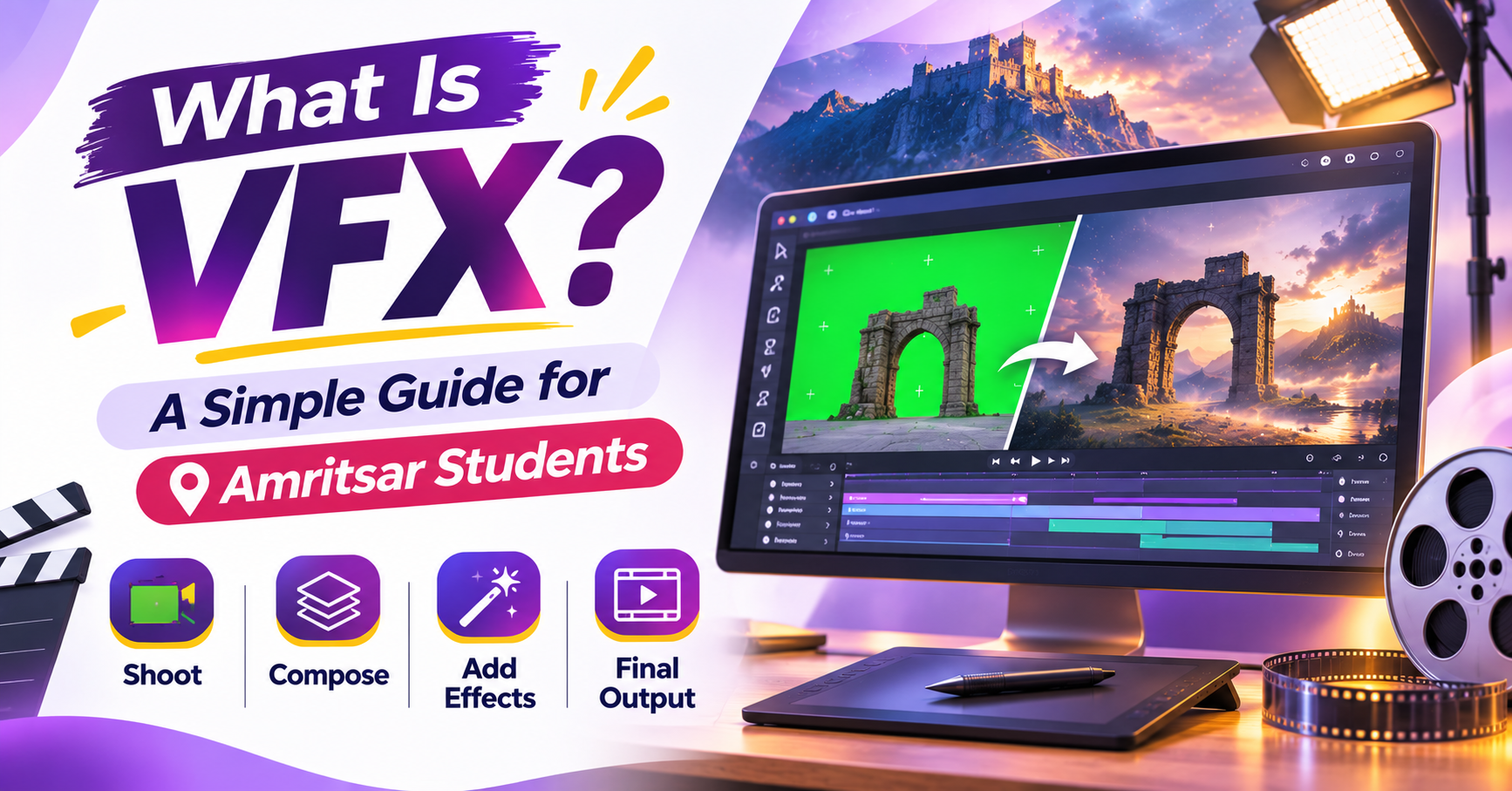
VFX can be used to add elements that were not present during the original filming. For example, a filmmaker may shoot an actor in front of a green screen and later replace the background with a city, space station, mountain, or fictional environment.
VFX is different from simply adding filters or effects to a video. Professional VFX involves techniques such as compositing, tracking, rotoscoping, keying, 3D modeling, texturing, lighting, simulation, and color correction.
The goal is usually to make the final image look believable and visually engaging.
Why Is VFX Important in Modern Media?
Today, audiences expect visually impressive content. Movies, web series, advertisements, music videos, games, social media videos, and even educational content use visual effects in different ways.
For example, VFX can help filmmakers:
Create imaginary environments
Add realistic weather effects
Remove unwanted objects
Replace backgrounds
Create explosions and fire
Design futuristic cities
Make characters interact with digital objects
Create creatures and monsters
Repair or enhance footage
Combine multiple video elements into one scene
VFX can also reduce production limitations. Instead of physically building an expensive location or set, filmmakers can create or enhance it digitally.
Major Types of VFX
VFX is a broad field containing several specialized areas. Students interested in a VFX Course in Amritsar should understand these major categories.
1. Compositing
Compositing is one of the most important areas of VFX. It involves combining multiple visual elements into a single final shot.
For example, an actor may be filmed separately from a background. A compositor combines the actor, background, lighting effects, shadows, particles, and other elements to create one seamless scene.
Software such as Nuke and Adobe After Effects is commonly associated with compositing workflows.
2. Green Screen and Chroma Keying
Green screen technology allows filmmakers to replace a solid-colored background with another environment.
An actor can be recorded in a studio and later placed inside a forest, spaceship, stadium, or fictional world.
The process of removing the green background is called keying or chroma keying.
3. Rotoscoping
Rotoscoping involves manually or digitally separating a person or object from the background.
For example, if a character needs to be placed into another scene, the VFX artist may create a detailed mask around the character.
Rotoscoping requires patience, precision, and attention to detail.
4. Motion Tracking
Motion tracking allows artists to follow the movement of objects or cameras in footage.
Suppose a camera moves around a building. A VFX artist can track that movement and add a digital object so that it appears naturally attached to the scene.
Tracking is widely used in movies, advertisements, title sequences, and product videos.
5. 3D Modeling and Animation
3D VFX involves creating digital objects, environments, and characters.
Artists can model buildings, vehicles, creatures, props, machines, and entire environments in 3D software.
These models can then be textured, rigged, animated, and rendered for use in films, games, advertisements, and other media.
6. Simulation Effects
Some visual effects are designed to imitate natural or physical phenomena.
Examples include:
Fire
Smoke
Water
Dust
Rain
Snow
Destruction
Explosions
Cloth movement
Simulation tools allow artists to create complex effects digitally without physically creating dangerous or expensive situations on set.
How Does a VFX Shot Work?
A professional VFX shot usually passes through multiple stages.
First, the footage is captured during production. The VFX team then studies the shot and determines what needs to be added, removed, or modified.
The next stage may involve tracking, rotoscoping, modeling, animation, or other processes depending on the project.
Artists then create or integrate digital elements. Lighting, shadows, reflections, colors, and textures are adjusted so that the elements match the original footage.
Finally, compositing brings everything together.
The completed shot is reviewed and rendered before being included in the final film or video.
This shows that VFX is not one single skill. It is a combination of artistic creativity, technical knowledge, observation, and problem-solving.
Popular VFX Software Students Can Learn
Students beginning their VFX journey can explore different software depending on their area of interest.
Some commonly used tools include:
Adobe After Effects – motion graphics, compositing, visual effects, and animation
Nuke – professional node-based compositing
Autodesk Maya – 3D modeling, animation, and production
Blender – 3D modeling, animation, simulation, and rendering
Adobe Photoshop – image preparation, matte painting, and texture work
Mocha – planar tracking and rotoscoping
Silhouette – professional roto and paint workflows
3D Equalizer – advanced camera tracking
Students do not need to master every software program immediately. It is better to build strong fundamentals and gradually specialize.
Skills Needed for a VFX Career
Learning software is important, but successful VFX artists need more than technical knowledge.
Creativity
VFX is a creative field. Artists need to imagine how a scene can look and find visual solutions to production challenges.
Observation
Small details can make a huge difference. VFX artists need to observe lighting, shadows, perspective, movement, colors, and textures carefully.
Patience
Some VFX tasks can be repetitive and time-consuming. Rotoscoping, tracking, cleanup, and compositing often require precision.
Technical Understanding
Students should gradually understand concepts such as resolution, frame rate, rendering, layers, masks, lighting, cameras, and color.
Problem-Solving
Every VFX shot can present a different challenge. Artists need to experiment and find effective solutions.
Career Opportunities After Learning VFX
VFX skills can lead to different creative and technical career paths.
Depending on their interests and training, students can explore roles such as:
VFX Artist
Compositor
Rotoscopy Artist
Matchmove Artist
3D Modeler
3D Animator
Texture Artist
Motion Graphics Artist
VFX Editor
Lighting Artist
Environment Artist
FX Artist
Previsualization Artist
VFX professionals can work with film production companies, animation studios, advertising agencies, post-production houses, gaming companies, television production teams, and digital content studios.
Some professionals also choose freelance work and collaborate with clients remotely.
How Can Amritsar Students Start Learning VFX?
Students in Amritsar who want to enter the creative media industry can start by learning the fundamentals rather than immediately focusing on advanced effects.
A structured VFX Course in Amritsar can help students understand the workflow step by step.
A good learning path can begin with basic video and image editing, followed by compositing, masking, keying, tracking, rotoscoping, and motion graphics. Students interested in 3D can then explore modeling, texturing, lighting, animation, and rendering.
Practical projects are especially important. Instead of only watching tutorials, students should create their own VFX shots.
For example, beginners can try removing an object from a video, replacing a background, creating a simple screen replacement, adding particles, or compositing a person into a different environment.
Building a portfolio from such projects can help students demonstrate their abilities.
Why VFX Can Be a Good Career Choice
VFX combines technology and creativity, making it suitable for students who enjoy visual storytelling and digital tools.
The field also connects with several industries. A student who starts with VFX can later explore animation, filmmaking, motion graphics, 3D design, gaming, advertising, or virtual production.
However, students should understand that becoming a professional VFX artist takes practice. Software knowledge alone is not enough. Strong fundamentals, portfolio projects, creativity, and continuous learning are essential.
Conclusion
VFX is much more than adding spectacular explosions to movies. It is a detailed creative process that combines footage, digital graphics, animation, compositing, tracking, modeling, lighting, and other techniques to create convincing visual experiences.
For students in Amritsar, VFX can provide an exciting pathway into filmmaking, animation, advertising, gaming, and digital media. By learning the fundamentals, practicing regularly, exploring industry-standard tools, and building a strong portfolio, beginners can gradually develop the skills required for a professional creative career.
If you are interested in visual storytelling and enjoy working with technology and creativity, VFX can be a rewarding skill to explore and develop in Amritsar.
- VFX
- Visual Effects
- VFX Course
- VFX for Beginners
- Compositing
- Rotoscoping
- VFX Course Amritsar
- Motion Tracking