VFX Artist Salary and Job Roles in India: Ludhiana Guide
VFX & Compositing · Nandini · 27 November 2026
Explore VFX artist salaries and job roles in India with this Ludhiana-focused guide. Learn about career options such as compositing, 3D, rotoscopy, matchmoving, FX, lighting and VFX supervision, plus essential skills, software and portfolio tips.
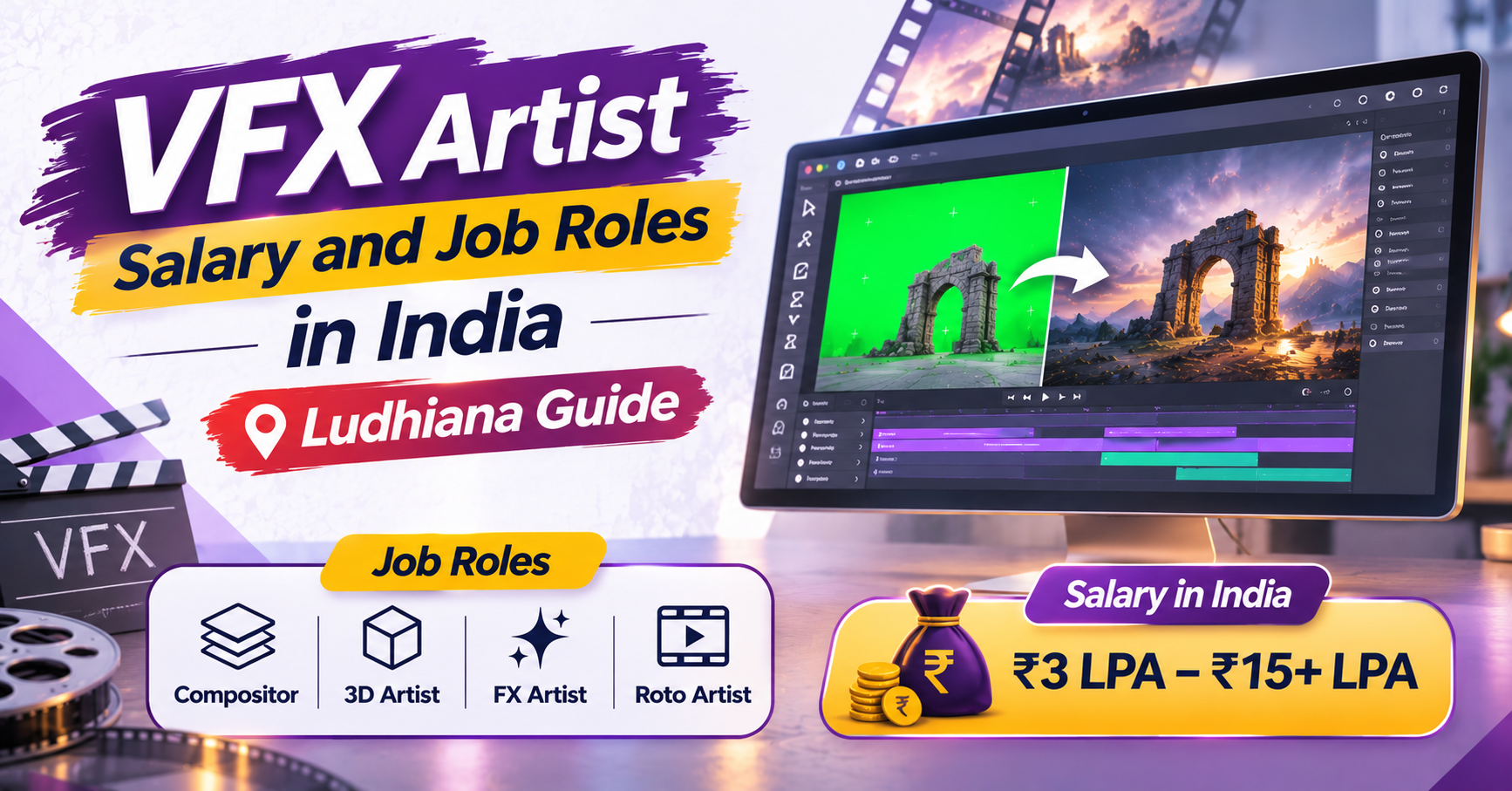
VFX Artist Salary and Job Roles in India: Ludhiana Guide
Visual Effects, commonly known as VFX, has become an important part of modern filmmaking, OTT content, advertising, animation, gaming, and digital media. From creating realistic explosions and magical environments to removing unwanted objects and integrating computer-generated elements into live-action footage, VFX artists help turn creative ideas into believable visuals.
For students in Ludhiana who are interested in animation, filmmaking, editing, or digital art, VFX can offer several career paths. However, it is important to understand that “VFX Artist” is not just one job role. The industry is divided into specialised departments such as compositing, rotoscoping, matchmoving, 3D, lighting, FX, and supervision.
Salary also varies significantly according to specialisation, experience, portfolio, software skills, studio, and location. Current Indian salary sources show a broad range, with entry-level VFX roles commonly starting around ₹2.5–5.5 lakh per year, while experienced specialists and supervisors can earn considerably more.
What Does a VFX Artist Do?
A VFX artist creates, modifies, or integrates visual elements that are difficult, expensive, or impossible to capture with a camera.
For example, a VFX team may create:
Fire, smoke, explosions, and water effects
Digital environments and backgrounds
Creatures and fantasy characters
CGI objects
Green-screen replacements
Wire and object removal
Weather effects
Digital crowds
Realistic shadows, lighting, and reflections
Cinematic compositing
VFX artists may work with live-action footage, 2D graphics, 3D assets, simulations, and computer-generated imagery. Their work often involves collaboration with directors, editors, animators, 3D artists, cinematographers, and VFX supervisors.
VFX Artist Salary in India
There is no single fixed salary for a VFX artist. Two people with the same job title can have very different salaries because one may specialise in Nuke compositing while another works in roto, lighting, or Houdini FX.
For a general career guide, the following ranges can be used as approximate industry benchmarks:
ExperienceApprox. Annual SalaryFresher / Trainee₹2–4.5 LPAJunior Artist₹3–5.5 LPAMid-Level Artist₹5–9 LPASenior Specialist₹8–15 LPAVFX Supervisor₹12–25+ LPA
These figures are indicative rather than guaranteed salaries. Current sources show substantial variation depending on role and experience. For example, one 2026 salary guide places roto and paint roles around ₹2.5–4 LPA at entry level, while senior FX Technical Directors can reach ₹14–20+ LPA.
Another current salary dataset estimates higher national averages, demonstrating why students should treat online salary figures as benchmarks rather than fixed offers.
Top VFX Job Roles
1. Rotoscopy Artist
A Roto Artist separates people, objects, or other elements from a video frame by creating detailed masks around them.
Rotoscopy is often one of the entry points into professional VFX production because it teaches artists how to work accurately with footage, masks, shapes, and frame-by-frame movement.
Skills: Rotoscoping, masking, tracking, attention to detail and patience.
2. Paint and Cleanup Artist
Paint artists remove unwanted elements from footage. This can include wires, rigs, logos, dust, unwanted objects, or other visual imperfections.
This role requires excellent observation and precision because the repaired area needs to blend naturally with the surrounding footage.
3. Matchmove Artist
Matchmoving connects real camera movement with a digital 3D environment.
A Matchmove Artist analyses footage and recreates camera movement or object movement in 3D software. This allows CG elements to appear as though they were actually captured by the camera.
Skills: Tracking, camera solving, 3D software, and spatial understanding.
4. Compositor
Compositing is one of the most important VFX departments.
A compositor combines different elements—such as live-action footage, CGI, green-screen footage, matte paintings, particles, and effects—into one convincing final shot.
Tools such as Nuke, Adobe After Effects, and Fusion are commonly associated with compositing workflows.
A strong compositor needs knowledge of colour, lighting, perspective, masking, keying, tracking, and visual storytelling.
5. 3D Artist
A 3D artist can work on modelling, texturing, lighting, animation, or environment creation.
Depending on their specialisation, they may create:
Buildings
Vehicles
Characters
Props
Digital environments
Product visuals
Cinematic assets
Software such as Maya, Blender, 3ds Max, and other industry tools can be useful depending on the department.
6. FX Artist
FX artists create simulations such as fire, smoke, explosions, water, destruction, dust, and other dynamic effects.
This is a highly technical area of VFX. Artists interested in this career path can benefit from learning Houdini and developing a strong understanding of physics and procedural workflows.
Current salary data indicates that FX Technical Directors with strong Houdini skills can reach some of the highest specialist salary levels in the VFX industry.
7. Lighting Artist
Lighting artists create and adjust lighting for 3D scenes so that digital objects appear believable.
They work with:
Light sources
Shadows
Reflections
Colour
Exposure
Mood
Material response
Good lighting can make the difference between a digital scene looking artificial and looking cinematic.
8. VFX Supervisor
A VFX Supervisor is a senior professional who oversees the visual-effects process.
They may work with directors during planning and production, supervise technical decisions, coordinate departments, review shots, and ensure that the final visual effects meet creative requirements.
This is generally a senior career position requiring substantial production experience.
VFX Career Opportunities for Ludhiana Students
Ludhiana can be a good place to start learning VFX, build a portfolio, and develop foundational skills. However, students should understand the geography of the Indian VFX industry.
Major production opportunities are concentrated in cities such as Mumbai, Hyderabad, Bengaluru, Chennai, Pune, and NCR, while Ludhiana has a smaller local VFX ecosystem.
This does not mean a Ludhiana student has to permanently relocate. The industry increasingly includes remote, freelance, advertising, social-media, gaming, and digital-content opportunities.
A practical career strategy can therefore be:
Learn in Ludhiana → Build a showreel → Gain project experience → Apply to studios/freelance → Specialise → Grow into senior roles.
Skills You Need to Become a VFX Artist
Software knowledge is important, but simply knowing software is not enough.
Students should develop:
Visual observation
Creativity
Colour understanding
Composition
Basic design principles
Storytelling
Problem-solving
Attention to detail
Communication
Time management
Teamwork
They should also learn industry-relevant software according to their chosen specialisation.
For example:
Compositing: Nuke, After Effects, Fusion
3D: Maya, Blender, 3ds Max
FX: Houdini
Tracking: 3D Equalizer and other tracking tools
Editing: Premiere Pro, DaVinci Resolve
The goal should not be to learn every software package. Instead, students should become highly capable in the tools relevant to their desired VFX department.
Portfolio Matters More Than Just a Certificate
One of the biggest mistakes beginners make is focusing only on completing a course or collecting certificates.
VFX is a highly practical field. Employers want to see what you can actually create.
A strong portfolio or showreel can include:
Before-and-after compositing shots
Green-screen work
Rotoscopy examples
Tracking shots
CGI integration
Matte-painting work
Cleanup shots
3D environments
FX simulations
Short cinematic sequences
A well-made showreel can demonstrate your technical ability much more effectively than a list of software names on a resume.
Is VFX a Good Career in India?
For students who genuinely enjoy filmmaking, animation, technology, and visual storytelling, VFX can be a rewarding career.
India has a large AVGC ecosystem, and VFX continues to support film, television, OTT, advertising, gaming, and other forms of digital content. Government documents have also highlighted VFX and gaming as important growth areas within the broader AVGC sector.
However, students should enter the field with realistic expectations. VFX can involve tight deadlines, long production schedules, repeated revisions, and highly detailed work. Success usually comes from skill development, specialisation, portfolio quality, and production experience, rather than simply completing a course.
Final Thoughts
A career in VFX offers much more than the generic title of “VFX Artist.” You can build a career as a Roto Artist, Paint Artist, Matchmove Artist, Compositor, 3D Artist, Lighting Artist, FX Artist, Technical Director, or eventually a VFX Supervisor.
For students in Ludhiana, the smartest approach is to start by learning the fundamentals, choose a specialisation, practise consistently, create a professional showreel, and then explore opportunities across India and the global freelance market.
If you are passionate about turning imagination into realistic visuals, VFX can be a strong creative and technical career option to explore after school or college.
- VFX Artist
- VFX Course
- VFX Career
- VFX Salary
- VFX Jobs
- VFX in Ludhiana
- 3D Animation
- VFX Training