How to Build a Graphic Design Portfolio That Gets Clients: Jalandhar
Design, AI & Marketing · Nandini · 27 November 2026
Learn how to build a professional graphic design portfolio that attracts clients in Jalandhar. Discover tips for selecting projects, creating case studies, showcasing branding and social media designs, presenting your work professionally, and turning your creative skills into client opportunities.
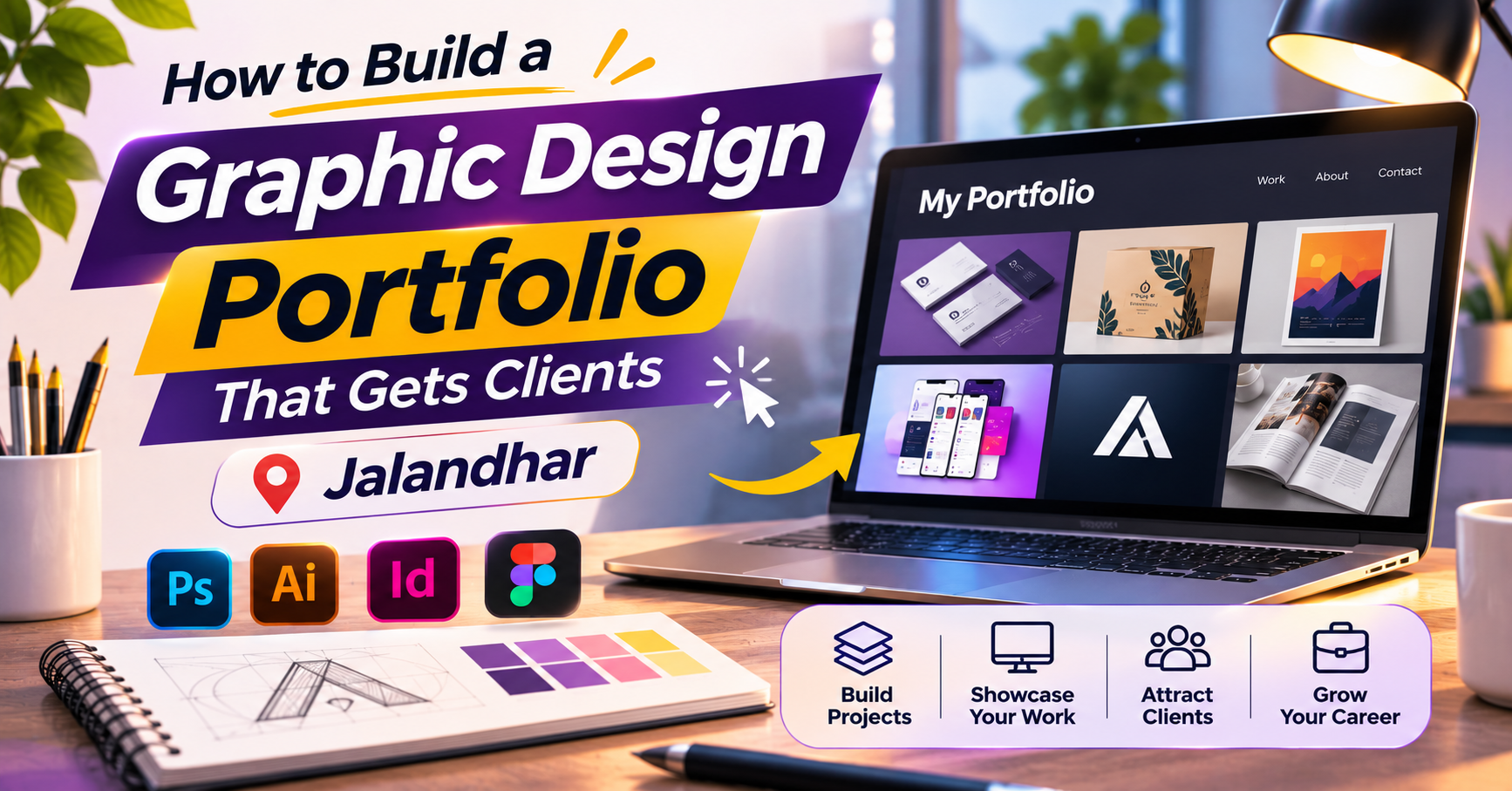
How to Build a Graphic Design Portfolio That Gets Clients: Jalandhar
A graphic design portfolio is one of the most important tools for anyone looking to build a career or attract clients in the creative industry. Whether you are a student, freelancer, beginner, or aspiring professional, your portfolio gives potential clients a clear idea of what you can create.
For students and designers in Jalandhar, having a strong portfolio can make it easier to showcase skills to local businesses, agencies, startups, and remote clients. A good portfolio does not simply display attractive designs. It demonstrates your creativity, design thinking, technical skills, consistency, and ability to solve real communication problems.
This guide explains how to build a graphic design portfolio that gets clients, what projects to include, how to present your work, and how beginners in Jalandhar can create a professional portfolio.
What Is a Graphic Design Portfolio?
A graphic design portfolio is a collection of your best design projects presented in an organized and professional way.
It can include work such as:
Logo designs
Brand identity projects
Social media posts
Posters
Brochures
Packaging designs
Business cards
Website designs
Advertisement creatives
Typography projects
UI designs
Presentation designs
Illustration work
Your portfolio should communicate more than “I know Photoshop or Illustrator.” It should show how you use design tools to create meaningful visual solutions.
Why Is a Portfolio Important for Getting Clients?
Clients usually want to see examples before hiring a designer. They want to know whether your style, quality, and creative approach match their requirements.
A strong portfolio can help answer important questions:
What type of designs can you create?
Is your work professional?
Can you maintain visual consistency?
Do you understand branding?
Can you design for different audiences?
Can you follow a brief?
Can you solve visual communication problems?
For freelancers, a portfolio can work like a visual resume. Instead of explaining every skill, you can demonstrate it through completed projects.
1. Choose a Clear Design Specialization
One common mistake beginners make is trying to show everything they have ever designed.
A better approach is to identify the type of graphic design work you want to attract.
For example, you might specialize in:
Social media design
Branding
Logo design
Advertising design
Print design
Packaging
UI/UX
Illustration
Marketing creatives
You can still include different types of work, but your portfolio should have a clear direction.
If you want to work with local businesses in Jalandhar, for example, you could create branding, restaurant menus, promotional posters, social media campaigns, and advertisement designs for fictional or real-world business scenarios.
2. Include Your Best Work, Not Everything
Quality is more important than quantity.
A portfolio with 8–12 strong projects can be more effective than one containing 50 average designs.
Before adding a project, ask yourself:
Does this project demonstrate a useful skill?
Does it look professional?
Does it represent the type of work I want to get hired for?
Would I be comfortable showing this to a potential client?
If the answer is no, consider removing it.
Your portfolio should represent your strongest abilities and your current design level.
3. Create Realistic Projects
Beginners often struggle because they do not have enough client work. The solution is to create realistic practice projects.
You can create fictional brands and design complete campaigns for them.
For example, create a fictional Jalandhar-based café and develop:
Logo
Brand colours
Menu
Instagram posts
Promotional poster
Business card
Outdoor advertisement
This creates a complete branding case study instead of showing one isolated logo.
You can also redesign existing fictional concepts or create your own campaign ideas. Clearly label self-initiated projects as concept work.
4. Show the Design Process
Clients are interested in the final result, but showing your process can make your portfolio more convincing.
Instead of showing only the final logo, explain how you developed it.
A project presentation might include:
Brief: What was the design requirement?
Research: What audience and competitors were considered?
Concept: What visual idea did you develop?
Design: How did you translate the concept into graphics?
Final Result: What does the completed design look like?
This demonstrates that you understand design thinking rather than simply creating attractive visuals.
5. Build Strong Branding Projects
Brand identity projects can be particularly valuable because they demonstrate several graphic design skills at once.
For one fictional company, you could create:
Logo
Colour palette
Typography system
Business card
Letterhead
Packaging
Social media templates
Advertisement designs
Presenting these together shows clients that you can maintain consistency across different communication materials.
This is especially useful if your goal is to attract businesses that need ongoing design support.
6. Focus on Presentation
Even a good design can look weak if it is presented poorly.
Use clean mockups and professional layouts to display your work.
For example, instead of displaying a logo on a plain white page, show how it might appear on:
Packaging
Signboards
Business cards
Product labels
Social media profiles
Storefronts
However, do not let mockups overpower the actual design. The portfolio should make your work easy to understand.
Keep backgrounds, spacing, typography, and project layouts consistent.
7. Create Social Media Design Case Studies
Social media has created many opportunities for graphic designers.
Businesses need designs for Instagram, Facebook, LinkedIn, YouTube, advertisements, stories, and promotional campaigns.
Instead of showing one random social media post, create a complete campaign.
For example, design a fictional campaign for a clothing brand with:
Launch post
Product announcement
Promotional creative
Festival post
Story design
Advertisement banner
This shows clients that you understand visual consistency and campaign design.
8. Use Professional Design Tools
A strong portfolio should demonstrate practical knowledge of professional design software.
Depending on your specialization, you may work with tools such as:
Adobe Photoshop
Adobe Illustrator
Adobe InDesign
Figma
CorelDRAW
Canva
Adobe Express
However, software skills should support your design abilities rather than become the entire focus of your portfolio.
Clients care about the final result, communication, creativity, and problem-solving.
9. Make Your Portfolio Easy to Navigate
Your portfolio should be simple to browse.
Organize projects into categories such as:
Branding
Social Media
Print Design
Advertising
UI/UX
Illustration
Each project should have a clear title and short explanation.
Avoid filling every page with unnecessary text. Let the visuals remain the primary focus.
10. Add Your Contact Information
A portfolio should make it easy for potential clients to contact you.
Include:
Name
Professional title
Email
Phone number if appropriate
Portfolio or website link
Social media/professional profile
Location, if relevant
You can also include a simple call to action such as:
“Have a project in mind? Let’s work together.”
Do not make potential clients search for your contact information.
Where Can Jalandhar Designers Find Clients?
Once your portfolio is ready, start sharing it strategically.
Local businesses can be a good starting point. Jalandhar has businesses across retail, hospitality, education, food, fitness, real estate, healthcare, fashion, and other sectors.
You can approach businesses with relevant design ideas rather than sending generic messages.
For example, if a restaurant has inconsistent social media graphics, you can show how a professionally designed campaign could improve its visual presentation.
You can also explore freelance platforms, professional networking websites, creative communities, internships, agencies, and remote opportunities.
Learn Graphic Design Through Practical Projects
If you are a beginner, structured learning can help you build both technical and creative skills.
A Graphic Design Course in Jalandhar can introduce students to design principles, typography, colour theory, composition, branding, image editing, vector graphics, layout design, and professional software.
The most valuable part of training, however, is practical project work.
Students should regularly create projects and turn their strongest work into portfolio pieces.
Common Portfolio Mistakes to Avoid
Avoid these common mistakes:
Adding too many weak projects
Copying designs without understanding them
Using inconsistent layouts
Showing only software screenshots
Using excessive text
Including outdated work
Forgetting contact information
Using poor-quality mockups
Showing unfinished projects
Focusing only on trends
Your portfolio should feel professional, intentional, and relevant to the type of clients you want.
Conclusion
A graphic design portfolio is more than a collection of images. It is a presentation of your skills, creativity, process, and ability to solve visual problems.
For aspiring designers in Jalandhar, the best approach is to create a focused portfolio with strong projects, realistic case studies, professional presentation, and a clear specialization. Even without extensive client experience, students can build impressive portfolios through self-initiated projects and practical assignments.
Keep improving your work, study professional design, experiment with different industries, and update your portfolio regularly. A well-built portfolio can help you move from simply learning graphic design to attracting real clients and building a professional creative career.
- Graphic Design
- Graphic Design Portfolio
- Portfolio Design
- Graphic Design Course
- Graphic Design Jalandhar
- Social media design
- Design Portfolio
- Branding Design