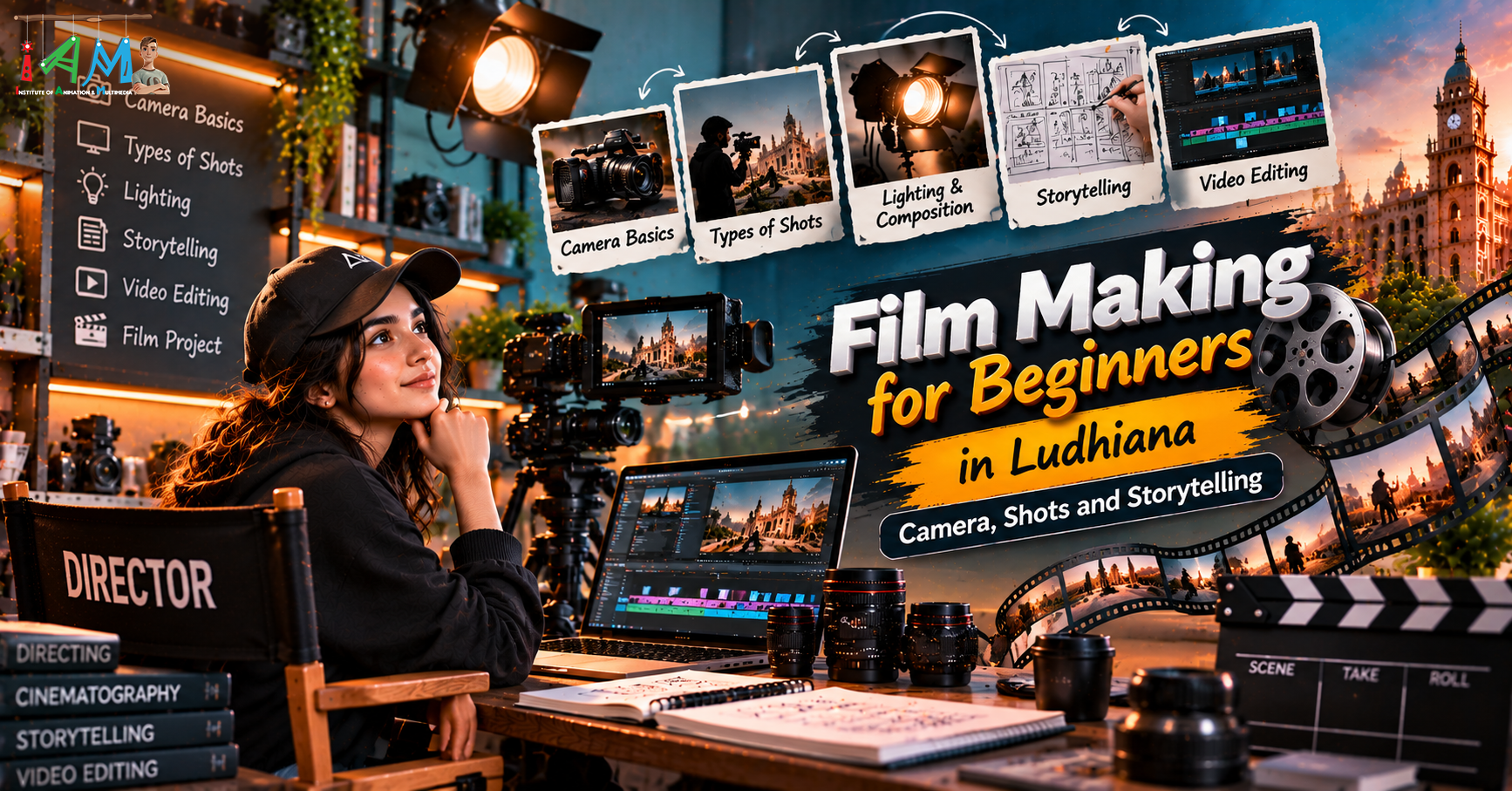
Film Making for Beginners in Ludhiana: Camera, Shots and Storytelling
Film & Editing · Nandini · 27 October 2026
Discover film making for beginners in Ludhiana and learn camera settings, shot types, camera angles, lighting, and storytelling techniques. Explore essential filmmaking skills, editing basics, and career opportunities to start your journey in the creative industry.
Film Making for Beginners in Ludhiana: Camera, Shots and Storytelling
Film making is an exciting creative field that combines storytelling, camera techniques, lighting, sound, and editing to create engaging visual experiences. From short films and music videos to advertisements, documentaries, and web series, film making plays an important role in today's entertainment and digital media industries. If you are a beginner looking to explore this creative profession, learning the fundamentals of film making is the perfect place to start.
For students and aspiring filmmakers in Ludhiana, understanding camera operations, different types of shots, and storytelling techniques can help build a strong foundation for a creative career. With the growing demand for video content across social media, television, advertising, and online streaming platforms, practical film making skills can open doors to exciting opportunities.
In this guide, we will explore the essential concepts every beginner should understand before starting their film making journey.
What Is Film Making?
Film making is the process of creating a film or video by combining visual storytelling, sound, performance, and editing. It involves several stages, including pre-production, production, and post-production.
Each stage contributes to the final quality of a film.
Pre-production: This is the planning stage. It includes developing a story, writing a script, creating a storyboard, selecting locations, arranging equipment, and planning the shoot.
Production: This is when the actual filming takes place. The filmmaker works with cameras, lighting, actors, and other crew members to capture the required footage.
Post-production: After filming, the recorded footage is edited. This stage may include colour correction, sound design, visual effects, music, and the final export.
Understanding these stages helps beginners see how an initial idea transforms into a finished visual story.
1. Understanding Camera Basics
The camera is one of the most important tools in film making. However, creating professional-looking footage requires more than simply pressing the record button. Beginners need to understand how camera settings affect the appearance, movement, and mood of a scene.
Camera Settings Every Beginner Should Know
Frame Rate: Frame rate refers to the number of frames recorded per second (FPS). Different frame rates create different visual effects.
24 FPS: Commonly used for a cinematic appearance.
25 or 30 FPS: Often used for television, online videos, and general video production, depending on the delivery requirements.
50 or 60 FPS: Useful for smoother motion and slow-motion effects when played back at a lower frame rate.
Shutter Speed: Shutter speed affects motion blur in recorded footage. A commonly used starting point is a shutter speed approximately double the frame rate. For example, when filming at 24 FPS, a shutter speed near 1/48 or 1/50 second can produce natural-looking motion.
Aperture: Aperture controls how much light enters the camera through the lens. It also affects depth of field, which determines how much of the image appears in focus.
ISO: ISO controls the camera sensor's sensitivity to light. Higher ISO settings can help in darker environments, but they may introduce unwanted image noise.
Learning these settings helps beginners capture clear, balanced, and visually appealing footage in different lighting conditions.
2. Learn the Different Types of Camera Shots
Camera shots are essential storytelling tools. They determine what the audience sees and how much information a scene communicates.
Understanding shot types helps filmmakers guide the viewer's attention, establish locations, and express emotions.
Wide Shot
A wide shot shows the subject within its surroundings. It is useful for introducing a location, showing a character's environment, or establishing the setting of a scene.
For example, a wide shot of a busy Ludhiana market can establish the location before the story focuses on an individual character.
Medium Shot
A medium shot typically frames a person from around the waist upward. It is commonly used for conversations, interviews, and scenes where both body language and facial expressions matter.
Close-Up Shot
A close-up focuses on a person's face or an important object. It helps communicate emotions and draw attention to significant details.
For example, a close-up of a character's nervous expression can make a dramatic scene more engaging.
Extreme Close-Up
An extreme close-up highlights a very small detail, such as an eye, a hand holding a photograph, or a finger pressing a button. This shot can create suspense or emphasise an important moment.
Over-the-Shoulder Shot
This shot is commonly used during conversations. The camera looks past one character's shoulder towards another character, helping the audience understand the relationship between the speakers.
Point-of-View Shot
A point-of-view (POV) shot shows what a character sees. It allows the audience to experience a scene from the character's perspective.
Beginners should practise these shots using a smartphone or camera. Recording the same subject from different distances can help them understand how framing influences storytelling.
3. Understand Camera Angles and Movements
Camera angles and movements influence the way viewers perceive characters, locations, and events.
Eye-Level Angle: The camera is positioned approximately at the subject's eye level. It creates a natural and balanced perspective.
Low Angle: The camera looks upward towards the subject, which can make the character appear powerful, confident, or intimidating.
High Angle: The camera looks down at the subject. Depending on the context, it can make a character appear vulnerable or show their position within a larger environment.
Bird's-Eye View: The camera looks directly down from above. This angle is useful for showing patterns, layouts, and the relationship between objects.
Filmmakers also use movement to make scenes more dynamic.
Pan: The camera rotates horizontally from a fixed position.
Tilt: The camera rotates vertically.
Tracking Shot: The camera moves alongside or towards the subject.
Dolly Shot: The camera moves closer to or farther away from the subject.
Handheld Shot: The camera is operated by hand to create a natural or documentary-style feeling.
Beginners should practise these techniques carefully. Smooth, purposeful movement is generally more effective than unnecessary camera motion.
4. Storytelling: The Heart of Film Making
A good film is not simply a collection of beautiful shots. It needs a story that connects with the audience.
Storytelling gives meaning to camera angles, lighting, sound, and editing. Even a short video can become memorable when it communicates a clear idea or emotion.
Start with a Simple Idea
Beginners do not need complicated stories. A short film about friendship, ambition, family, or overcoming a challenge can be an excellent starting point.
For example, a student in Ludhiana dreams of becoming a filmmaker but struggles to find the confidence to create their first video. After several attempts, they finally complete a short film. This simple concept has a character, a challenge, and a resolution.
Develop a Beginning, Middle, and End
A basic story structure can make filmmaking easier.
Beginning: Introduce the character and the situation.
Middle: Show the challenge, conflict, or problem.
End: Present the outcome or resolution.
This structure helps the audience follow the story without unnecessary confusion.
Use Visual Storytelling
Filmmakers should learn to communicate through images instead of relying entirely on dialogue.
For example, a messy desk, an unfinished project, and a clock showing late-night hours can suggest that a character is working under pressure.
Small visual details can communicate emotions, establish the setting, and reveal information about a character.
5. Learn Composition and the Rule of Thirds
Composition refers to how visual elements are arranged within the frame. Good composition helps direct the viewer's attention and makes shots easier to understand.
The rule of thirds is a useful technique for beginners. Imagine dividing the frame into nine equal sections using two horizontal and two vertical lines. Placing the subject near these lines or their intersections can create a balanced image.
However, the rule of thirds is a guideline rather than a strict requirement. Centre framing, symmetry, and unusual compositions can also be effective when they support the story.
Beginners should also pay attention to the background, available space, leading lines, and unwanted objects that may distract viewers.
6. Lighting and Sound: Essential Elements of a Film
Lighting and sound are just as important as camera work. Poor lighting can make a scene difficult to understand, while unclear audio can distract viewers from an otherwise excellent video.
Basic Lighting Techniques
Natural light is an affordable starting point for beginners. Shooting near a window can provide soft, attractive lighting for interviews and dialogue scenes.
Artificial lights can be used to control brightness, shadows, and the overall mood of a scene. A basic three-point lighting setup uses:
Key Light: The primary light source illuminating the subject.
Fill Light: Reduces harsh shadows created by the key light.
Back Light: Separates the subject from the background.
Why Sound Matters
Good audio makes a film feel more professional. Beginners should record dialogue in quiet environments, monitor background noise, and use an external microphone when possible.
Sound effects, background ambience, and music can also help create atmosphere. However, music should complement the scene rather than overpower dialogue.
7. Practise Film Editing and Post-Production
Once filming is complete, the next step is editing. Editing involves selecting the best takes, arranging shots, controlling pacing, and creating a smooth sequence.
Beginners can start by learning basic editing skills, such as cutting clips, arranging scenes, synchronising audio, adding transitions, and adjusting colour.
Popular professional editing tools include Adobe Premiere Pro and DaVinci Resolve. The right choice depends on your learning goals, equipment, and budget.
A useful beginner exercise is to record a one-minute story and edit it into a short film. This project helps develop camera awareness, continuity, pacing, and storytelling skills.
8. Career Opportunities After Learning Film Making
Film making offers several career paths for people who enjoy visual creativity and practical production work.
Some potential roles include:
Filmmaker: Develops and creates films or video projects.
Cinematographer: Plans and manages the visual appearance of a production.
Camera Operator: Operates cameras during filming.
Assistant Director: Helps coordinate the production process and shooting schedule.
Video Editor: Organises and edits recorded footage.
Documentary Filmmaker: Creates factual films about people, places, and events.
Content Creator: Produces videos for brands, digital platforms, and online audiences.
Advertising Film Producer: Helps develop and produce promotional videos and commercials.
Career opportunities depend on practical experience, portfolio quality, communication skills, and industry requirements. Building a showreel and working on independent projects can help beginners demonstrate their abilities.
9. Choose the Right Film Making Course in Ludhiana
If you want structured guidance, joining a film making course in Ludhiana can help you understand the technical and creative aspects of filmmaking.
When comparing courses, look for practical camera training, shot composition, script development, lighting techniques, sound recording, direction, and editing.
A good training programme should also encourage students to create short films, work on practical assignments, collaborate with others, and build a portfolio.
The Institute of Animation & Multimedia (IAM) offers a creative learning environment for students interested in exploring film making and related multimedia fields. Before enrolling, review the current syllabus, practical facilities, course duration, and available project opportunities to ensure they match your career goals.
Whether you want to become a cinematographer, director, editor, or independent content creator, a strong foundation in filmmaking can help you take your first steps towards a creative career.
Conclusion
Film making combines technical knowledge with imagination and storytelling. By learning camera settings, practising different shots, understanding composition, experimenting with lighting, and developing simple stories, beginners can gradually improve their filmmaking skills.
For aspiring filmmakers in Ludhiana, the best way to start is to create short projects, learn from mistakes, and keep experimenting with new techniques.
- Film Making Course in Ludhiana
- Film Making for Beginners
- Camera Techniques
- Cinematography Basics
- Film Making Training
- Storytelling Techniques
- Video Production Course
- Film Making Career