A Day in the Life of an Animator: What the Job Looks Like
Design, AI & Marketing · Jaspreet · 27 October 2026
Ever wondered what animators actually do all day? Follow a typical workday step by step, from morning dailies and reference gathering to blocking, polishing and review, and see the skills you need to start your own animation career.
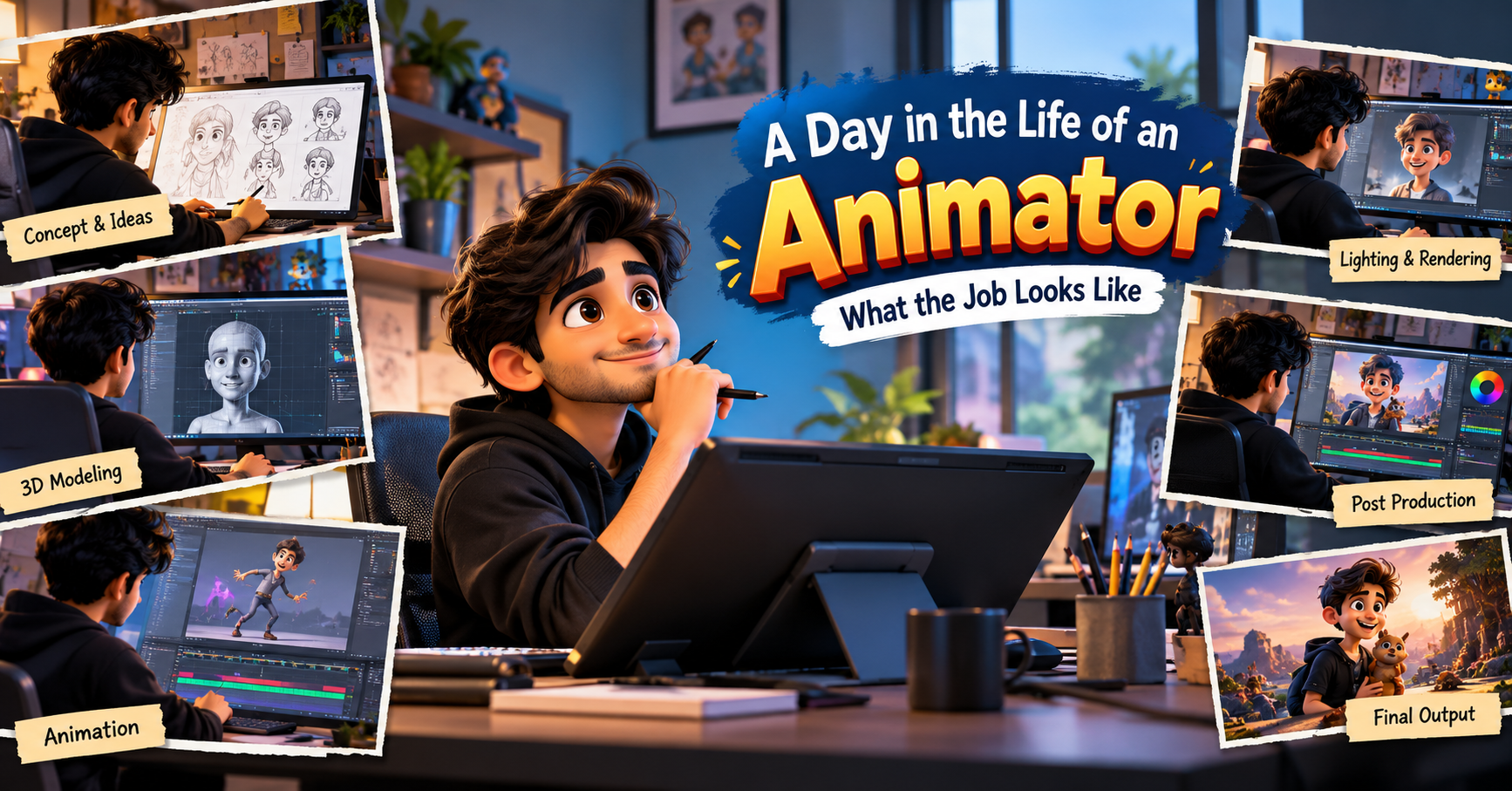
A Day in the Life of an Animator: What the Job Looks Like, Step by Step
Many people picture animation as drawing cartoons all day. The real job is a mix of art, problem-solving, teamwork and deadlines. If you’re thinking about animation as a career, or you’re a student wondering what happens after the course ends, here is what a typical day looks like, hour by hour.
Step 1: Start the Day with a Plan (9:30 AM)
Most animators begin by checking their task list in a production tracking tool such as ShotGrid or Trello. Each task is usually one shot, a single continuous piece of animation lasting a few seconds.
Before opening any software, a good animator asks three questions:
What is the shot supposed to show?
What feedback did the director or supervisor leave yesterday?
What is the deadline for this shot?
Spending ten minutes on this saves hours of rework later.
Step 2: The Morning Team Meeting, or “Dailies” (10:00 AM)
Studios hold a daily review session, often called dailies. The animation supervisor or director plays everyone’s latest work on a big screen and gives notes.
Notes sound like this:
“The anticipation before the jump needs two more frames.”
“His eyes should lead the head turn.”
“This feels floaty. Give me more weight on the landing.”
New animators often find this nerve-racking. Experienced ones treat it as the most useful part of the day. Feedback isn’t personal. It is how a shot gets better.
Step 3: Gather References (10:45 AM)
Before animating, professionals study real movement. This is where the best animators separate themselves from average ones.
Video reference: Many animators film themselves acting out the scene on a phone. How does your shoulder move when you lift something heavy? Where does your weight shift?
Real-world footage: For animal or creature work, they study documentaries and slow-motion clips.
Thumbnail sketches: Quick drawings to plan key poses and timing.
Good reference makes the difference between a character that moves and a character that lives.
Step 4: Block Out the Key Poses (11:15 AM)
Now the actual animation begins. Most 3D animators work in software like Maya or Blender, and they don’t start by making everything smooth. They start with blocking.
Blocking means setting only the most important poses of the shot, such as the start, the peak of the action and the end, and leaving everything else rough and stepped. At this stage the shot looks choppy on purpose.
Why? Because it lets you check storytelling, timing and composition quickly. If the story isn’t working in blocking, polishing it won’t fix it.
Step 5: Lunch and a Real Break (1:00 PM)
Animation is a screen-heavy, detail-heavy job. Eye strain and neck and wrist pain are common. Most animators step away from the computer at lunch, and many use the 20-20-20 rule (every 20 minutes, look at something 20 feet away for 20 seconds).
Step 6: Refine the Motion (2:00 PM)
After lunch comes the longest and most technical stage: turning rough blocking into smooth, believable motion.
This involves:
Adding breakdowns: in-between poses that define the arcs of movement.
Working in the graph editor: adjusting curves to control speed, easing and overlap.
Applying the principles of animation: squash and stretch, follow-through, overlapping action, arcs and exaggeration. These twelve principles, developed at Disney, still guide professionals today.
Checking the playback constantly: animators play their shot dozens of times, looking at it frame by frame and at full speed.
This is where patience matters. Moving a single finger’s timing by two frames can change how a whole performance feels.
Step 7: Collaborate with Other Departments (4:00 PM)
Animation never happens in isolation. During the day, animators may talk to:
Riggers, if a character control isn’t behaving properly
Layout artists, about camera angles
Lighting and compositing artists, who take the animation further
VFX artists, if the shot includes effects like smoke, water or debris
Clear communication and a friendly attitude matter just as much as technical skill.
Step 8: Submit the Shot for Review (5:30 PM)
Before leaving, the animator renders a preview (called a playblast) and submits it for the next day’s dailies. Then the cycle repeats: notes, revisions, improvements, until the supervisor approves the shot as final.
A single shot can go through five, ten or even more rounds of feedback. That is normal.
What Skills Does an Animator Need?
Based on that day, here is what the job really requires:
A strong sense of timing and weight
Comfort with software like Maya, Blender or Toon Boom
Observation skills, meaning the habit of watching how people and animals move
Patience and willingness to accept feedback
Teamwork and communication
Time management under deadlines
The Honest Truth: The Good and the Challenging
The good:
You bring characters to life and tell stories
Every day is different
It’s a field where your showreel matters more than your degree
The challenging:
Deadlines can get intense, especially near release dates
Feedback cycles can feel repetitive
Mastery takes years of practice
How to Start Your Journey
If this day sounds exciting rather than exhausting, animation may suit you. Here is a simple path:
Learn the 12 principles of animation.
Practice basic exercises: the bouncing ball, the pendulum, a simple walk cycle.
Pick one software and learn it well.
Build a short demo reel of your best 30 to 60 seconds of work.
Join a structured course where you get regular feedback from industry mentors.
Final Thoughts
A day in the life of an animator is a mix of creativity, discipline and collaboration. It isn’t glamorous every hour, but watching a character you shaped frame by frame finally come alive on screen is a feeling few careers can match.
If you love movement, storytelling and problem-solving, animation could be a rewarding path, and every great animator started with a single bouncing ball
- animator
- day in the life of an animator
- Animation Career
- Animation Course
- 3D Animation
- Maya
- Blender
- animation workflow