6 Animation Career Paths You Can Start After 12th
Animation & Gaming · Nidhi Jalandhar · 20 October 2026
Explore 6 animation career paths after 12th, from 2D and 3D animation to VFX and motion graphics. Discover the skills, creative opportunities and training options that can help you choose a direction in animation and multimedia.
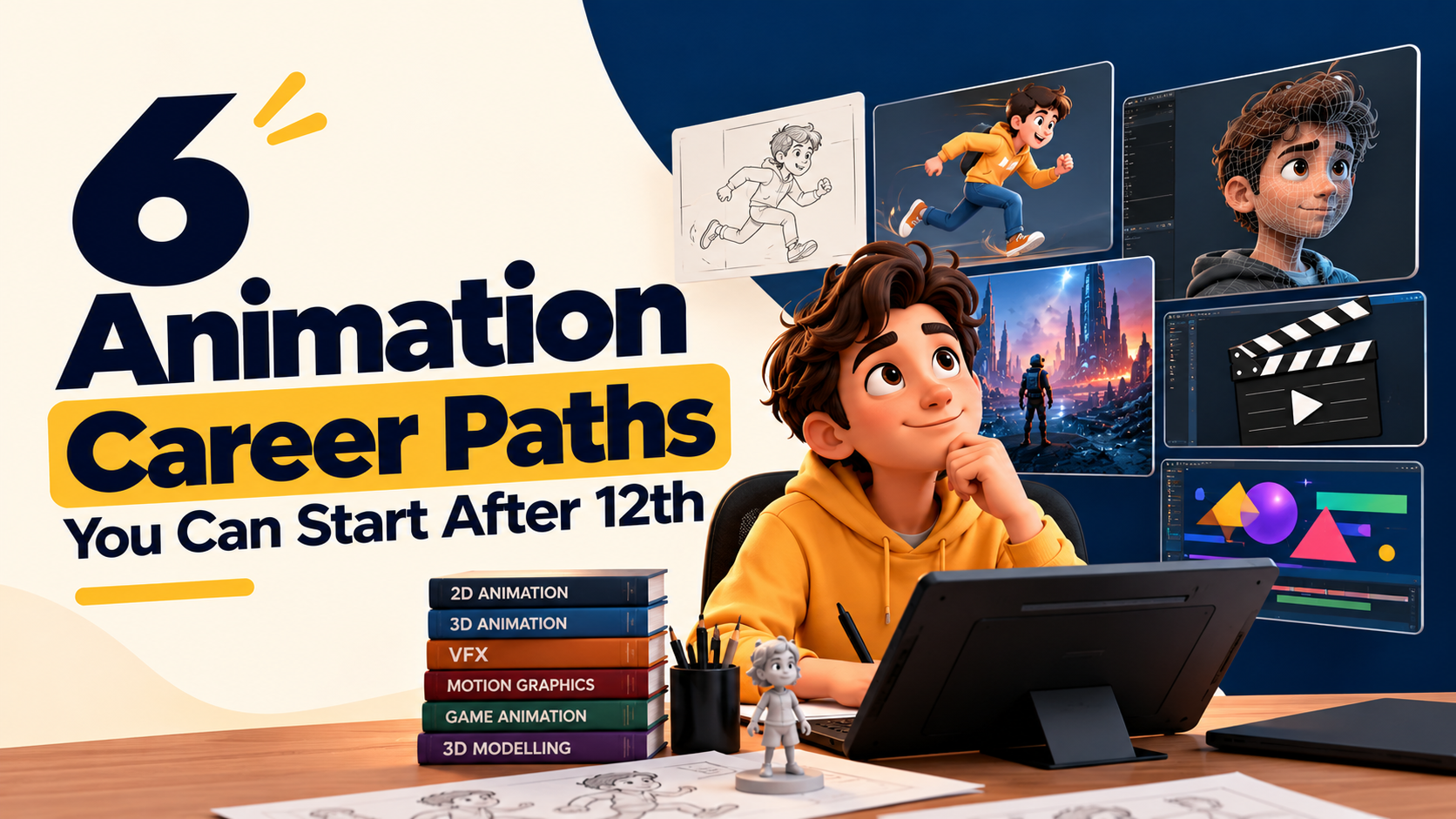
6 Animation Career Paths You Can Start After 12th
Have you ever watched an animated film, played a video game or seen an eye-catching motion graphic and wondered how it was created? Behind these visuals are creative professionals who combine imagination, design and technology to bring ideas to life.
If you have completed your 12th class and enjoy visual storytelling, animation and digital creativity, this field may be worth exploring. Animation is used in entertainment, advertising, gaming, education, product visualisation and online content.
The best career path depends on your interests, the skills you develop and the type of work you enjoy. Here are six animation-related career paths you can explore after 12th.
1. 2D Animator
Do you enjoy cartoons, illustrated stories and expressive characters? 2D animation may be a good direction to explore.
A 2D animator creates movement in a two-dimensional space. This can involve drawing characters, planning poses, arranging frames and adjusting timing so that actions look natural and communicate the intended emotion.
What you can learn:
Character movement and expressions
Keyframes and frame-by-frame animation
Timing, spacing and basic animation principles
Storyboarding and visual storytelling
Digital drawing and animation tools
Where this work is used: Animated videos, cartoons, educational content, advertisements and short digital stories.
This path may suit students who enjoy illustration, storytelling and creating movement through drawings.
2. 3D Animator
If you are interested in digital characters, realistic movement and three-dimensional environments, 3D animation could be another option.
A 3D animator works with digital models and scenes to create movement. The process may involve understanding character rigs, keyframes, camera angles, timing and how objects behave in a scene.
What you can learn:
Fundamentals of 3D space
Keyframe animation
Character and object movement
Camera movement and scene composition
Basic lighting and rendering concepts
Where this work is used: Films, animated series, games, product videos and visual presentations.
Students who enjoy experimenting with digital environments and technical tools may find this area interesting.
3. VFX Artist
Visual effects, commonly called VFX, help combine or enhance visual elements that may be difficult, expensive or impossible to capture directly during filming.
VFX work can include compositing, removing unwanted elements, creating environmental effects and combining live-action footage with digital imagery. It is related to animation but often involves a different workflow and specialised tools.
What you can learn:
Visual compositing fundamentals
Working with layers and masks
Basic effects and motion tracking
Green-screen concepts
Digital image and video workflows
Where this work is used: Films, television, advertisements, music videos and online productions.
This career direction may interest students who enjoy filmmaking, visual experimentation and solving technical creative problems.
4. Motion Graphics Designer
Motion graphics combine typography, shapes, icons, illustrations and movement to communicate a message. You may have seen them in animated logos, promotional videos, video introductions and digital advertisements.
Unlike character-focused animation, motion graphics often concentrate on presenting information or branding in a visually engaging way.
What you can learn:
Animated typography
Shape animation and transitions
Composition and visual hierarchy
Logo animation
Timing, pacing and design consistency
Where this work is used: Advertising, social media videos, brand explainers, presentations and digital campaigns.
This option may suit students who enjoy graphic design and want to combine visual layouts with animation.
5. 3D Modelling Artist
Before many 3D objects can be animated, someone needs to create their digital form. A 3D modelling artist builds objects, props, characters or environments using specialised software.
Modelling focuses on shape, proportion, surface detail and the structure of digital objects. Depending on the specialisation, artists may create simple product models, detailed environments or character assets.
What you can learn:
Basic 3D modelling techniques
Object shapes and proportions
Mesh editing and surface detail
Materials and textures
Preparing models for presentation or animation
Where this work is used: Animation, games, product visualisation, advertising and some architectural visualisation workflows.
If you like building digital objects and paying attention to detail, 3D modelling may be worth exploring.
6. Game Animation Artist
Video games use animation to make characters, creatures, objects and environments feel responsive. Game animation artists help create movements that support gameplay and communicate actions clearly.
The work may include walking cycles, running, jumping, interaction animations and other character actions. Depending on the role, artists may also need to understand how animations are prepared for use in a game engine.
What you can learn:
Character movement and action sequences
Animation timing and posing
Basic rigging concepts
Animation cycles
Introduction to game-engine workflows
Where this work is used: Video games, interactive experiences and some virtual or augmented reality projects.
This path may appeal to students who enjoy gaming and want to understand how interactive characters are brought to life.
Which Animation Career Path Is Right for You?
You do not have to decide your specialisation on the first day. Exploring a few basic projects can help you understand what you enjoy and where your strengths lie.
Enjoy drawing and storytelling? Explore 2D animation.
Interested in digital characters and movement? Try 3D animation.
Love film effects and visual experimentation? Explore VFX.
Prefer design, typography and transitions? Consider motion graphics.
Enjoy building digital objects? Look into 3D modelling.
Interested in interactive characters and gaming? Explore game animation.
These paths can overlap, and some professionals develop skills in more than one area over time.
What Skills Should You Develop After 12th?
Animation is a creative discipline, but technical understanding and consistent practice are important too. You can begin building a foundation by working on:
Observation: Study how people, animals and objects move in real life.
Visual storytelling: Learn how poses, expressions, composition and timing communicate ideas.
Software familiarity: Explore suitable animation tools and practise their basic workflows.
Patience and attention to detail: Small adjustments can make a major difference to movement and visual quality.
Portfolio development: Save your strongest projects and show how your skills improve over time.
You do not need to master every software package at once. Start with the basics and gradually work towards more complex projects.
How to Choose an Animation Course After 12th
Before enrolling in an animation programme, check the syllabus and make sure it matches your preferred area. A course focused on motion graphics may not cover the same subjects as a programme centred on 3D character animation or VFX.
Ask the institute about the software taught, practical assignments, trainer feedback, project work and portfolio guidance. Also check the entry requirements, course duration and computer specifications needed for learning at home.
Look for a programme that helps you practise the skills you want to develop rather than relying only on software demonstrations.
Start Exploring Animation and Multimedia
Completing 12th class can be the beginning of your journey into animation and multimedia. Whether your interest lies in 2D storytelling, 3D scenes, visual effects, motion graphics, modelling or gaming, the first step is to understand the field and start practising.
The right learning path depends on your interests, the quality of your practice and the portfolio you build. Research your options, compare course syllabuses and choose a direction that gives you room to develop your creative and technical skills.
- Animation, Animation Career, Animation Careers After 12th
- , Animation Courses After 12th, 2D Animation
- 3D Animation, VFX,
- Motion Graphics
- Motion Graphics, 3D Modelling
- Animation Course in Jalandhar
- Animation Institute in Jalandhar
- Character Animation