2D vs 3D Animation: Which Career Path Should Students Choose in Amritsar?
3D Animation & Modelling · Nandini · 27 November 2026
Compare 2D and 3D animation and discover which career path may suit students in Amritsar. Learn about skills, software, applications, career opportunities, and practical training to help you choose the right animation field for your creative goals.
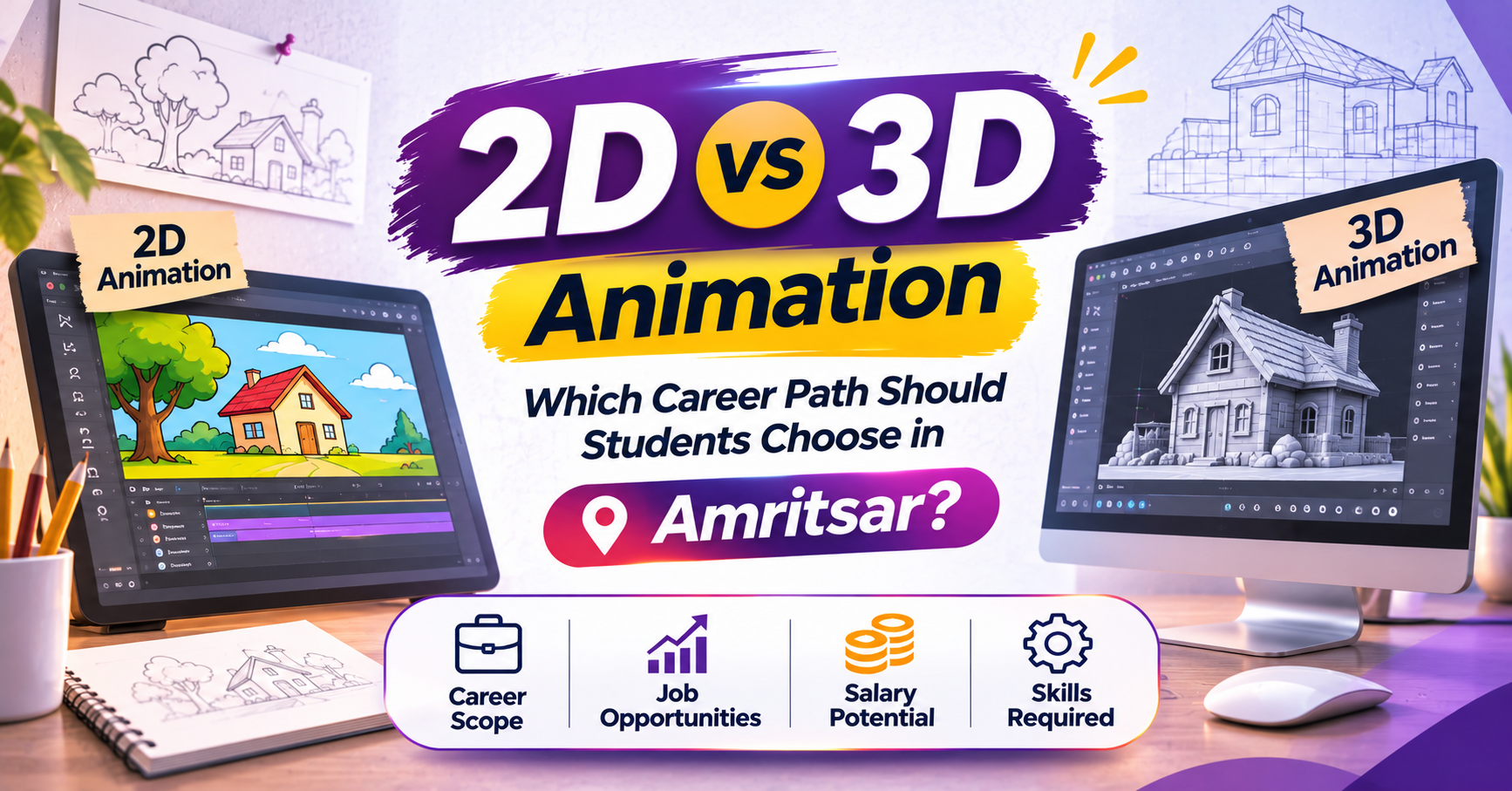
2D vs 3D Animation: Which Career Path Should Students Choose in Amritsar?
Animation has become one of the most exciting career fields for students who enjoy creativity, storytelling, technology, and visual design. From animated films and advertisements to games, educational content, social media videos, and digital experiences, animation is used across many industries.
For students in Amritsar who are considering an animation career, one common question is: Should I learn 2D animation or 3D animation?
Both fields offer interesting career opportunities, but they require different skills, workflows, and creative approaches. Understanding the difference between 2D and 3D animation can help students choose a learning path that matches their interests and career goals.
This guide explains the differences between 2D and 3D animation, their applications, required skills, software, career opportunities, and how students can choose the right option in Amritsar.
What Is 2D Animation?
2D animation creates movement using artwork that primarily exists on a flat, two-dimensional plane.
Traditional cartoons are a familiar example of 2D animation. Modern digital 2D animation uses software to create characters, backgrounds, objects, and motion.
2D animation can be created frame by frame or through digital rigging and keyframe-based animation.
Popular applications include:
Cartoon series
Explainer videos
Educational content
Advertisements
Motion graphics
Social media content
Animated illustrations
Short films
Mobile games
2D animation can have a hand-drawn, graphic, illustrated, or highly stylized appearance.
What Is 3D Animation?
3D animation involves creating objects, characters, and environments in a three-dimensional digital space.
Unlike 2D animation, 3D objects have depth and can be viewed from different angles. Artists can model a character, apply textures, create lighting, rig the character, and animate its movement.
3D animation is widely used in:
Animated movies
VFX
Video games
Product visualization
Architectural visualization
Advertising
Virtual production
Television
Simulation
Augmented and virtual reality
3D animation is particularly useful when realistic environments, characters, camera movements, and physical depth are required.
2D vs 3D Animation: Key Difference
The biggest difference is the way visual elements are created and manipulated.
In 2D animation, artists generally work with drawings, illustrations, shapes, and layers on a flat visual plane.
In 3D animation, artists work with digital models that exist inside a virtual three-dimensional environment.
For example, imagine creating a rotating car.
In 2D animation, an artist may draw different views of the car and animate those drawings.
In 3D animation, the artist can create a complete 3D model of the car and rotate the virtual camera around it.
Both approaches can produce excellent results, but the production process is different.
Skills Required for 2D Animation
Students interested in 2D animation should develop strong drawing and visual storytelling skills.
Important skills include:
Drawing fundamentals
Character design
Storyboarding
Timing and spacing
Keyframes
In-between animation
Character movement
Facial expressions
Composition
Colour theory
Storytelling
Understanding the principles of animation is especially important.
Students should learn concepts such as squash and stretch, anticipation, follow-through, overlapping action, timing, spacing, and exaggeration.
Skills Required for 3D Animation
3D animation requires a combination of artistic and technical abilities.
Students may learn:
3D modeling
Texturing
Lighting
Rigging
Character animation
Camera animation
Rendering
Materials
Environment creation
Basic physics and simulation
A 3D artist also needs to understand perspective, anatomy, movement, lighting, composition, and storytelling.
3D workflows can involve multiple specialized roles, so students may eventually choose an area such as modeling, animation, lighting, rigging, or texturing.
Software Used in 2D Animation
There are several tools available for 2D animation.
Common options include:
Adobe Animate
Adobe Photoshop
Toon Boom Harmony
OpenToonz
Blender Grease Pencil
Adobe After Effects
The best software depends on the type of animation a student wants to create.
For example, Adobe Animate is widely used for digital 2D animation, while Photoshop can be useful for frame-by-frame artwork and illustration.
Software Used in 3D Animation
3D animation also involves several professional tools.
Popular software includes:
Autodesk Maya
Blender
3ds Max
Cinema 4D
ZBrush
Substance 3D tools
Unreal Engine
Different software programs are used for different stages of production.
For example, Maya can be used for modeling, rigging, and animation, while ZBrush is particularly useful for digital sculpting. Blender offers a broad range of 3D capabilities in one platform.
Career Opportunities in 2D Animation
Students choosing 2D animation can explore several creative roles.
Possible career paths include:
2D Animator
Character Designer
Storyboard Artist
Illustrator
Motion Graphics Artist
Explainer Video Designer
Background Artist
Visual Development Artist
Animation Artist
2D skills can also be useful in advertising, social media, educational content, publishing, gaming, and digital marketing.
Career Opportunities in 3D Animation
3D animation offers a wide range of specialized career options.
Students can explore roles such as:
3D Animator
3D Modeler
Character Artist
Texture Artist
Lighting Artist
Rigging Artist
Environment Artist
3D Visualization Artist
VFX Artist
Game Artist
Because 3D is used across animation, gaming, VFX, advertising, architecture, and product visualization, students can potentially explore multiple industries.
Which Is Easier: 2D or 3D?
There is no universally easier option.
2D may feel more natural for students who enjoy drawing, illustration, and traditional art. However, professional 2D animation still requires considerable knowledge of movement, timing, storytelling, and software.
3D may appeal to students who enjoy technology, modeling, virtual environments, cameras, and realistic visuals. However, 3D production can involve a more complex technical workflow.
The right choice depends on the student's interests rather than which field appears easier.
Which Has Better Career Opportunities?
Both 2D and 3D animation can lead to careers, but their applications differ.
3D is heavily used in areas such as games, animated films, VFX, product visualization, architecture, and virtual production.
2D remains highly relevant for cartoons, advertisements, explainer videos, educational content, motion graphics, illustrations, and digital media.
Students should therefore think about the type of work they want to create rather than choosing a field only because they believe it has more opportunities.
How Should Amritsar Students Choose?
Students in Amritsar can begin by identifying their interests.
Choose 2D animation if you:
Enjoy drawing and illustration
Like cartoons and stylized visuals
Prefer working with flat artwork
Enjoy character design
Like storytelling through drawings
Want to explore motion graphics or illustrated content
Consider 3D animation if you:
Enjoy technology and digital tools
Like realistic environments
Are interested in games or VFX
Want to create 3D characters and objects
Enjoy modeling and virtual spaces
Are interested in filmmaking and cinematic visuals
There is also no rule saying you must remain limited to one field forever.
Many creative professionals develop skills across multiple disciplines.
Why Practical Training Matters
Whether you choose 2D or 3D, practical learning is extremely important.
A structured Animation Course in Amritsar can help students understand fundamentals while working on projects.
Instead of learning software commands alone, students should practice creating complete projects.
For 2D animation, this could include a bouncing ball, walk cycle, character animation, short advertisement, or explainer video.
For 3D animation, projects could include modeling a simple object, creating a 3D environment, animating a character, designing a product visualization, or producing a short cinematic sequence.
A portfolio containing such projects can help students demonstrate their abilities when applying for internships, jobs, or freelance opportunities.
Can Students Learn Both 2D and 3D?
Absolutely.
Learning both can provide a broader understanding of animation and visual storytelling.
A student may begin with 2D fundamentals and later move into 3D. Another student may start with 3D and explore 2D motion graphics or illustration.
Understanding both approaches can also help artists collaborate better with different creative departments.
However, beginners should avoid trying to master everything simultaneously. Building a strong foundation in one area first can make the learning process easier.
Conclusion
The choice between 2D and 3D animation depends largely on your interests, creative strengths, and career goals.
2D animation can be a great choice for students who enjoy drawing, illustration, stylized storytelling, and character design. 3D animation can be ideal for students interested in modeling, realistic environments, games, VFX, filmmaking, and digital production.
For students in Amritsar, the best approach is to explore both fields, understand their workflows, and choose the one that genuinely interests them. With consistent practice, professional software knowledge, creative thinking, and a strong portfolio, students can develop valuable skills for the growing digital media and entertainment industry.
Ultimately, there is no single “best” animation path. The best path is the one that matches your creativity, curiosity, and long-term career goals.
- 2D Animation
- 3D Animation
- Animation Course
- Animation Career
- Animation for Students
- 2D vs 3D Animation
- 3D Modeling
- Animation Course Amritsar