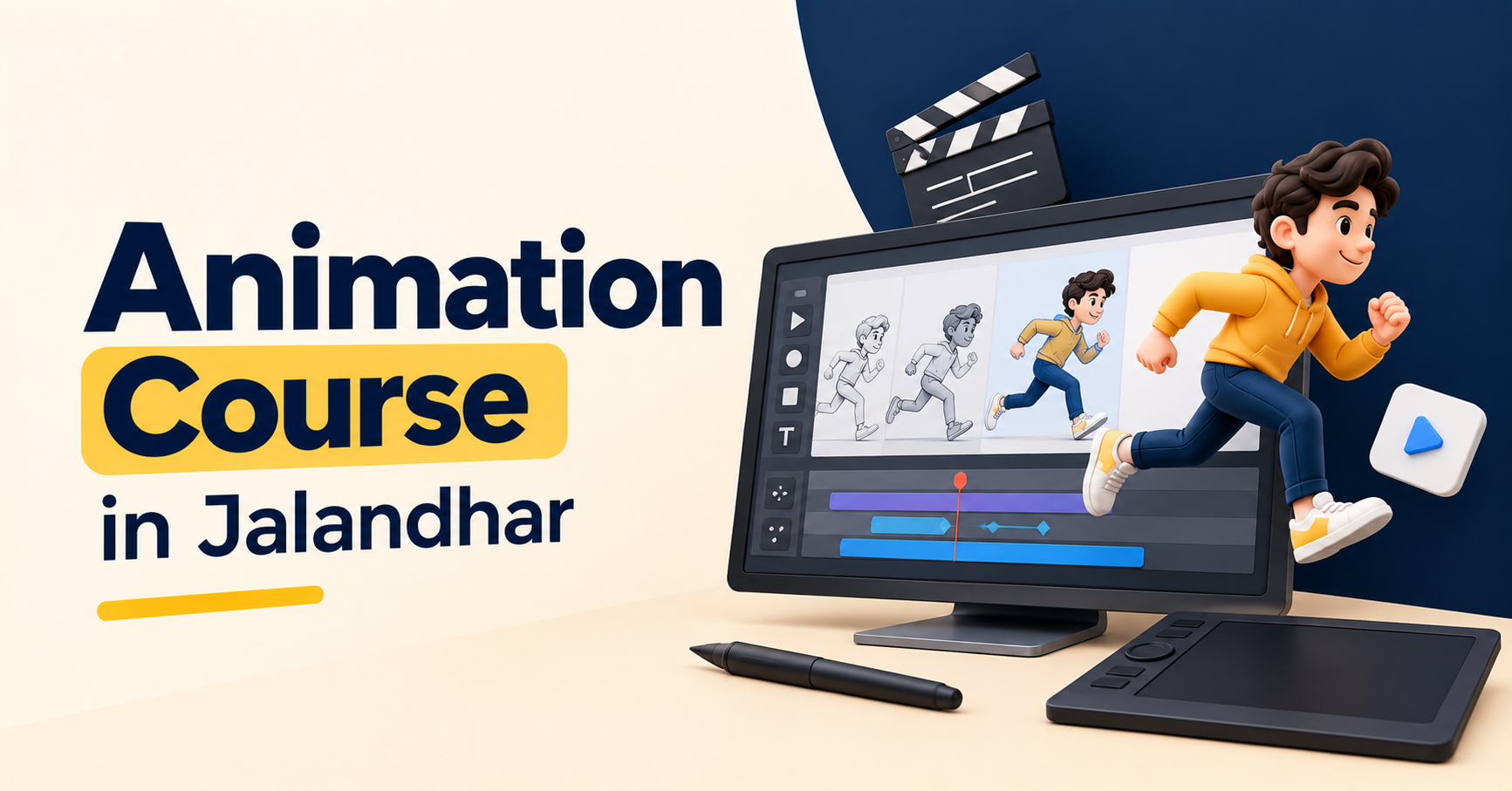
Animation Course in Jalandhar
Bring Ideas to Life With Animation
A character running across a screen, a product rotating in 3D, or a title moving smoothly through a video—all of these are examples of animation turning static ideas into visual experiences.
Animation combines creativity, timing, movement and technical skills. It is used in films, advertising, gaming, educational videos, product presentations and digital content. Behind every finished animation is a process that begins with an idea and develops through planning, design, movement and refinement.
If you are exploring an Animation Course in Jalandhar, this field may be worth considering if you enjoy drawing, storytelling, visual design or experimenting with digital tools. A structured course can help you understand the animation process and gradually develop your own creative projects.
What Does an Animator Actually Do?
Animation is more than moving an object on a screen. Animators create the impression of movement by arranging images, poses or digital objects in a sequence. They consider timing, spacing, expressions, composition and the way movement communicates an idea.
Depending on the type of animation, the work may involve designing characters, building 3D models, creating motion graphics, setting up digital scenes or refining movement frame by frame.
Understanding these different activities can help beginners discover which part of the animation process interests them most.
Explore the Different Types of Animation
Animation includes several creative specialisations, each with its own workflow and visual style.
2D Animation
Two-dimensional animation creates movement across a flat visual space. It can be used for cartoons, explainer videos, educational content, advertisements and short stories.
Learners may explore character poses, keyframes, frame-by-frame movement, backgrounds and basic principles such as timing and anticipation. Strong observation and an understanding of visual storytelling can help make movement feel natural.
3D Animation
Three-dimensional animation works with digital objects and characters that have depth. These elements can be placed in a scene, lit from different directions and animated to create more dimensional movement.
The process may involve modelling, rigging, keyframing, camera movement, materials, lighting and rendering. The exact workflow depends on the software and type of project being created.
Motion Graphics
Motion graphics bring text, shapes, illustrations, icons and graphic layouts to life. They are frequently used in promotional videos, title sequences, brand explainers, social media videos and presentations.
This area combines design with movement. Typography, transitions, pacing and visual hierarchy all contribute to how clearly the final animation communicates its message.
Character Animation
Character animation focuses on making digital or illustrated characters move and express emotions. Animators work with body language, facial expressions, poses and timing to communicate personality.
A convincing character does not simply move from one position to another. Its movement should suit the action, mood and situation in the scene.
Understand the Animation Production Process
A finished animation usually passes through several stages. Learning this workflow helps beginners understand how an initial concept becomes a completed visual project.
Concept and planning: Decide what the animation should communicate, who it is for and what the final output should look like.
Storyboarding: Arrange important moments into a visual sequence to plan the action, composition and flow of the story.
Design and asset creation: Prepare characters, objects, backgrounds, typography or other visual elements needed for the project.
Animation: Create movement using keyframes, frame-by-frame techniques or other methods suited to the project.
Lighting and visual refinement: For applicable 3D projects, adjust lighting, materials, cameras and scene details to achieve the intended look.
Rendering and editing: Produce the final frames or video, review the sequence and make corrections to timing, transitions, sound or visual consistency where needed.
The stages vary according to the animation format, but a planned workflow helps keep creative work organised.
Learn the Principles Behind Believable Movement
Animation becomes more convincing when movement is guided by clear principles. These ideas help an animator make actions easier to follow and give objects or characters a sense of weight and intention.
Important principles include squash and stretch, anticipation, staging, follow-through, arcs, timing, spacing and exaggeration. For example, anticipation prepares the viewer for an action, while follow-through helps movement feel less mechanical.
Beginners can practise these principles through small exercises before attempting complex scenes. A bouncing ball, a moving object or a simple character action can reveal a great deal about timing and movement.
Explore Animation Software and Digital Tools
Animation software provides tools for building, editing and refining visual sequences. The suitable software depends on the animation specialisation and the type of project.
Depending on the course syllabus, learners may explore tools such as Blender for 3D creation and animation, Autodesk Maya for professional 3D workflows, or Adobe After Effects for motion graphics and compositing. Other tools may be used for 2D animation, illustration or video editing.
Software knowledge is only one part of the learning process. Understanding composition, movement, storytelling and the reason behind each creative decision is equally important.
Before enrolling, ask which applications are included in the current course and whether students get guided practice with them.
Create Small Projects Before Attempting Complex Scenes
Animation skills develop through repeated practice. Instead of starting with a complicated film, beginners can work on smaller projects that focus on one technique at a time.
Possible practice exercises include:
Animating a bouncing ball with different timing and spacing.
Creating a short logo or typography animation.
Designing a simple animated character action.
Producing a rotating 3D product presentation.
Creating a short explainer animation with text and shapes.
Building a brief scene with a camera move and basic lighting.
These are examples of suitable practice projects, not a guarantee of the assignments offered by any particular institute. The actual course projects should be confirmed with the training provider.
Build a Portfolio That Shows Your Creative Thinking
A portfolio gives potential employers or clients a way to see how you approach visual problems. It can include finished animations, short clips, motion graphics, character exercises, storyboards or selected stages from a larger project.
Quality and clarity matter more than simply collecting a large number of files. Choose work that demonstrates your skills, explain your role in each project and show relevant process material where appropriate.
For animation roles, a focused showreel can be particularly useful because it presents movement and visual work in a concise format. Keep the reel relevant to the type of role you want to pursue.
Career Directions After Learning Animation
Animation skills can be applied across different creative industries. Depending on your interests, portfolio and level of proficiency, possible directions include:
2D Animator: Creates movement for illustrated characters, scenes and visual stories.
3D Animator: Animates digital characters, objects and environments.
Motion Graphics Designer: Creates animated text, graphics and visual sequences.
3D Modelling Artist: Builds digital objects, props and environments for animation or other visual applications.
Character Artist: Develops the visual appearance of characters.
Compositing Artist: Combines visual elements into a coherent final shot.
Video and Animation Editor: Assembles and refines visual sequences for presentation.
Freelance Animation Creator: Produces suitable animation work for clients and projects.
These roles have different skill requirements. Some require specialisation beyond an introductory course, and employment depends on portfolio quality, experience, technical ability and market demand.
Who Can Consider an Animation Course?
An animation course may be suitable for students, graduates, beginners and creative individuals interested in digital visual production. It can also appeal to people who enjoy illustration, films, gaming, advertising or visual storytelling.
You do not necessarily need to be an expert artist to begin learning animation. However, observation, patience, regular practice and a willingness to revise your work are valuable qualities. Check the institute's entry requirements and recommended computer specifications before joining.
Why Consider Animation Training in Jalandhar?
Learning locally can make it easier to compare training options and understand what support is available. When evaluating an animation programme in Jalandhar, look beyond the course title and review its actual syllabus, software coverage, project work and feedback process.
Ask whether the training covers 2D animation, 3D animation or motion graphics, how much practical work is included, and whether learners receive guidance on developing a portfolio. You can also enquire about class schedules, available lab facilities and the expected level of prior knowledge.
These details help you choose a course that matches your interests instead of enrolling based only on a broad description.
Start Your Animation Learning Journey
Animation brings together visual imagination and technical execution. With consistent practice, learners can develop an understanding of movement, scene design, storytelling and the tools used to produce digital animation.
If you are searching for an Animation Course in Jalandhar, contact IAM to request the latest syllabus, software details and information about practical projects. Choose a learning path that matches your interests and gives you a realistic opportunity to build your skills over time.
Turn Creative Ideas Into Moving Visual Stories
Explore animation principles, digital modelling, character movement, motion graphics and visual storytelling through structured animation learning.
Tell us whatyou wantto create.
A few lines about yourself and the course you're interested in. Our admissions team replies within two working days, and you can book a free campus visit or demo class.
Call admissions→Or send an enquiry to your nearest campus- Phone
- +91 98881 22241
- Address
- 1st Floor, IAM, Crystal Plaza, SCS 78, opp. PIMS Hospital, Jalandhar, Punjab 144001